
The technology already works in large data transfers in the financial sector in Denmark, and now Technical University of Denmark (DTU) spin-out company Alea Quantum Technologies developed a quantum mechanical random number generator that is so simple it can end up produced at a low price and support encryption of 4 gigabytes per second.
Speaking of simple, the technology is so simple it can also go into a chip version.
Alea Quantum Technologies’ random number generator originates from research in the quantum information group at DTU Physics and the basic research centre bigQ.

Five years ago, the researchers came up with an idea for a random number generator based on a laser diode and a detector used to form the random numbers through measurements of the vacuum fluctuations of laser light. DTU took out a patent for the technology, and this is the invention Alea Quantum Technologies developed into a prototype.
The device measures 3 x 5 centimeters and will end up tested by the company QTI, Quantum Telecommunication Italy. Under the Digital Europe program, the EU granted DKK 7 million (US$1.01 million) for the further development of the technology, which also in 2022 formed part of a larger system tested to deliver quantum-secured data transfer between two servers in Danske Bank.
Since then, the random number generator developed into a high-speed model ten times as fast as its closest market competitor.
The next step in the development will be to get strong investors to join the project to finance the development of a chip where the laser diode and detector are integrated in an electro-optical system on a micrometer scale.
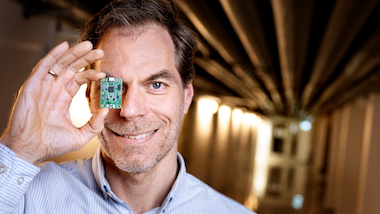
DTU Professor Ulrik Lund Andersen shows the latest version of a quantum mechanical randomness generator, which must end up reduced in chip size to go in the electronics of mobile phones.
Source: Bax Lindhardt
When this part of the technology development is in place, the price of the quantum mechanical random number generator will be so low it could work well for companies in the mobile phone market.
Alea Quantum Technologies expects to sell the chip version of the random number generator to QTI and other companies that want to test it in their own encryption systems. The tests will end up conducted in a collaboration between Alea and the individual companies, so the chip is able to integrate in the solutions with the right interfaces. Concurrently with the random number generator, Alea is also developing its own full encryption solution that will be available shortly.
Lund Andersen emphasizes the marketing of quantum technologies is still in a phase where researchers must refer to theoretical mathematical proofs. It is a crucial competitive parameter for Alea to show documentation they generate 100 percent genuine random numbers, unlike other encryption systems based on mathematical algorithms and are therefore not truly random.
“For our technology to integrate into commercial communications systems and become part of production networks and infrastructures, we depend on the establishment of new standards and certifications for quantum technologies,” said Lund Andersen. “The European standardization organization ETSI is among those working to develop this with expert input from researchers. It’s absolutely key to the development of a broad market that quantum technologies receive an international seal of approval. But, until then, the mathematical proofs guarantee security.”