
To that end, nearly half of security incidents handled from January to November 2021 were connected to ransomware, an increase of nearly 9 percent from 2020, said researchers at Kaspersky’s Global Emergency Response Team (GERT).
The trend prompted Kaspersky to name ransomware the Story of the Year, headlining its annual Kaspersky Security Bulletin series of predictions and analysis of key changes in the world of cybersecurity.
Ransomware made its rounds this year as it took down fuel pipelines, meat plants, water facilities and government health services just to name a few. Ransomware operators refined their arsenals, focusing on fewer attacks against large-scale organizations, and an entire underground ecosystem has appeared to support ransomware gangs’ efforts.
Over the first 11 months in 2021, the percentage of ransomware-related incident response requests processed by Kaspersky’s GERT team was 46.7 percent, a jump from 37.9 percent for all of 2020 and 34 percent for 2019.

Kaspersky’s Global Emergency Response Team is called in by companies after a security breach to limit the damage and prevent an attack from spreading. This is known as incident response and is reserved for mid-sized to large organizations.
The most common targets were those in the government and industrial sectors. Together, attacks against those two industries accounted for nearly 50 percent of all ransomware-related incident response requests in 2021. Other popular targets included IT and financial institutions.
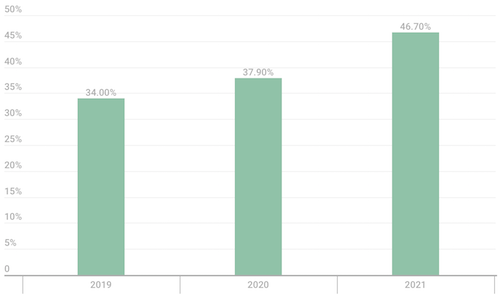
Percentage of ransomware-related incident response requests from 2019-2021.Source: Kaspersky
As ransomware operators shifted to bigger ransom demands and more high-profile targets, they’ve been facing increasing pressure from politicians and law enforcement agencies – making efficiency of attacks critical. As a result, Kaspersky experts note two important trends that will gain popularity in 2022. First, ransomware gangs are likely to construct Linux builds of ransomware to maximize their attack surface. This is something that has already been seen with groups like RansomExx and DarkSide.
In addition, ransomware operators will start to focus more on “financial blackmail.” This is when operators threaten to leak critical information about companies when they are undergoing critical financial events, such as conducting a merger or acquisition, or making plans to go public. When companies are in such a vulnerable financial state, they’re more likely to pay the ransom.
“We began talking about so-called Ransomware 2.0 in 2020, and what we’ve been seeing in 2021 is this new era of ransomware coming into full force,” said Vladimir Kuskov, head of threat exploration at Kaspersky. “Ransomware operators aren’t just encrypting data; they’re stealing it from critical, large-scale targets and threatening to expose the information if the victims don’t pay. And Ransomware 2.0 is going anywhere in the coming year.”
“At the same time, now that ransomware is in the headlines, law enforcement agencies are working hard to bring prolific groups down, which is what happened with DarkSide and REvil this year,” said Fedor Sinitsyn, security expert at Kaspersky. “These gangs’ lifecycles are being compressed, and that means they’re going to have to refine their tactics in 2022 to remain profitable, especially if some governments make paying ransoms illegal, which is being discussed.”
Click here for more on the report.