
The end result of this new technology is this equipment could prevent hydrogen vehicle accidents caused by impurities in the hydrogen fuel and improve the quality of hydrogen production, according to researchers at the Korea Research Institute of Standards and Science (KRISS).
Hydrogen fuel is more prone to contamination during production, transportation, and storage compared to conventional fuels because it is more complex than conventional fuel production. There is also high-pressure processes involved in storage, transportation, and usage which increases the likelihood of introducing impurities.
That can trigger unexpected chemical reactions, raising the risk of hydrogen explosions. Additionally, there is concern about secondary accidents due to a decrease in engine performance.

Slow Inspection Process
In Korea, the quality of hydrogen fuel ends up monitored by inspection agencies that visit fuel production sites quarterly, collect fuel samples, and measure impurities using specialized equipment.
However, this process presents significant challenges. Detecting impurities that occur outside the scheduled inspection periods is difficult, and identifying the root cause and nature of the issue proves to be even more complex, making it hard to provide effective, real-time assistance.
Although expensive foreign equipment ends up used on-site for testing impurities in hydrogen production, these devices can only analyze one or two components at a time. Additionally, the maintenance of such equipment is problematic, complicating the process of conducting thorough and continuous quality inspections.
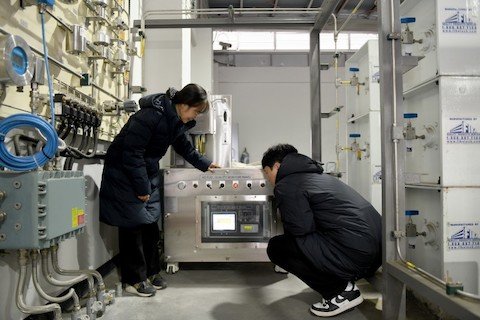
KRISS Principal Research Scientist Lee Jeongsoon (left) and Postdoctoral Researcher Kim Sang Woo (right) inspect the monitoring equipment installed at the hydrogen bus refueling station in Chungju City.
Source: KRISS
As hydrogen infrastructure – including refueling stations and production facilities – continues to expand, the demand for hydrogen fuel quality analysis has grown substantially. This surge in demand has highlighted the need for easy-to-use, domestically produced, real-time monitoring equipment that can ensure the quality of hydrogen fuel at all times.
KRISS’s Semiconductor and Display Metrology Group successfully developed equipment that monitors, in real-time, the components and concentrations of impurities in hydrogen fuel supplied to vehicles through refueling stations.
“The equipment displays both the measurement values and their uncertainty (the degree of doubt in the results),” said Dr. Lee Jeongsoon, principal research scientist at KRISS’s Semiconductor and Display Metrology Group, who developed the real-time monitoring equipment for hydrogen fuel quality. “The analysis values and uncertainty, obtained using standard materials, are traceable to standards, ensuring the reliability of the results.”
Accurate Measurements
The equipment developed by the research team is capable of accurately measuring eight of the fourteen impurities regulated by ISO. If the concentration of any impurity in the hydrogen fuel exceeds the standard threshold, the management system sends a warning signal, allowing the operator to detect and take action before contaminated fuel is injected into the vehicle.
The eight impurities measured: Water vapor (H₂O), Oxygen (O₂), Argon (Ar), Carbon dioxide (CO₂), Methane (CH₄), Carbon monoxide (CO), Nitrogen (N₂), Hydrogen sulfide (H₂S)
By applying the newly developed equipment at hydrogen refueling stations, it will be possible to continuously monitor and maintain the quality of hydrogen fuel, which should enhance the safety of hydrogen vehicles and reduce user concerns.
Additionally, at hydrogen production facilities, the equipment will enable easy and accurate inspection of the quality of the hydrogen fuel produced, which will further improve the quality of domestically produced hydrogen.
“We are currently conducting a demonstration of the equipment at the hydrogen bus refueling station in Chungju City, and after the demonstration is completed, we plan to transfer the technology to domestic companies,” Jeongsoon said.