
On top of that, 50 percent of all reported lifting incidents from 2014-2018 consisted of a load strike, less than 10 percent resulted in personal injury, and approximately 86 percent of reported lifting injuries involved contractors, according to a report with the Bureau of Safety and Environmental Enforcement (BSEE). Since May this year, every lifting incident reported to BSEE involved a segment of the operator’s contracted workforce.
All lifting incidents create the potential for injury and significant environmental and/or safety impact.
Knowing that, this past March BSEE Director Scott Angelle issued a challenge to a group of engineers, inspectors, and supervisors within BSEE’s district, regional, and HQ offices to identify potential immediate and longer-term actions that could end up considered by BSEE and industry as mitigation measures for reducing the occurrences and severity of future lifting incidents by the target goal of 50 percent.
This Safe Lifting Initiative Team observed most reported lifting incidents include a human component contributing to the event.

Support for that observation gained further validation from the ABS Crane Safety Assessment (2015), which reported 60 percent to 80 percent of the mishaps involved human errors.
Therefore, BSEE will seek to employ Safety and Environmental Management Systems (SEMS) methodology to identify specific programs or standard operating procedures to drive improvements in lifting safety performance.
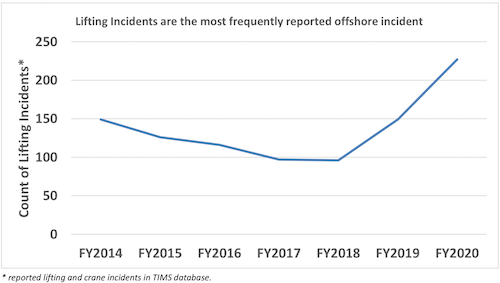
Count of Lifting Incidents Fiscal Year (FY) 2014 – 2020
Source: BSEE
BSEE recommended operators and contractors consider the following:
Improving pre-work planning: Pre-work planning may not reflect the dynamics of reality for the workplace and should be improved beyond completing a Job Safety Analysis (JSA). The majority (>80 percent) of the lifting incidents occurred during operations described as “routine” by the operator. Primary SEMS elements: Safe work practices, hazard analysis and recognition.
Obtaining better data on lifting incident causal factors: Incident data must end up collected with the goal of identifying the undesirable circumstances and behaviors to mitigate future occurrences. Primary SEMS elements: Investigation of incidents, safe work practices.
Identifying/Creating Training Opportunities: Rigger position training ended up identified as critical to improving safe work practices. Since most lifting incidents involve a human element, training should include recognition of human factors and the ability to recognize and mitigate hazards. Primary SEMS elements: Training, safe work practices, hazards analysis and recognition.