
The blast occurred July 26 at the C.Vale co-operative in the small town of Palotina, about 370 miles from the state’s capital Curitiba. Parana is one of Brazil’s top farm states.
C.Vale said in a statement the cause of the explosion remain unknown, according to a Reuters report.
A company spokesperson said at least seven of those who died were foreign workers, mostly Haitians, and one was Brazilian. C.Vale said the silo where the explosion occurred stored about 12,000 metric tons of soybeans and 40,000 metric tons of corn.

Jose Ricken, president of Parana’s farm cooperative group OCEPAR, said this was an isolated case, adding there had been no such incidents in the area “in a long time.”
A similar explosion took place in 1993, C.Vale confirmed.
Ricken declined to speculate on the causes of the explosion, deferring questions to authorities as investigations are ongoing.
Grain dust particles are highly combustible and can cause fires or explosions in confined spaces such as grain storage facilities, although it is unclear what happened in this case.
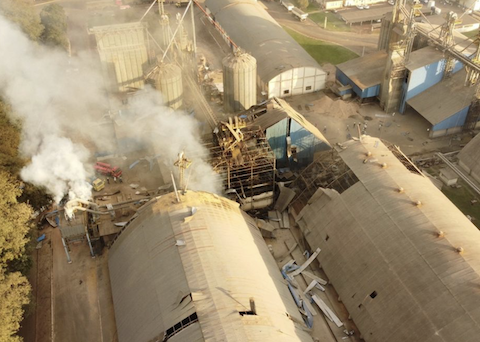
Aftermath of a series of explosions that occurred at grain silos owned by agro-industrial cooperative C. Vale, in the city of Palotina, Parana State, Brazil. Nine workers died and 11 suffered injuries.
Source: Brazil’s Parana Firefighters
The particles can be from wheat, oats, barley, or other types of grain that form layers or become airborne in an enclosed space. Research shows corn starch is one of the most dangerous and volatile.
Fire Department official Manoel Vasco said dogs were helping in the search for the missing worker potentially trapped under the rubble and grains.