
While the numbers may seem tiny, small businesses suffered either a hack (7 percent), virus (5 percent), or data breach (3 percent) in 2019, but regardless, they are looking to become more secure this year, new research found.
Of 383 small business owners and managers surveyed to better understand the challenges they had with cybersecurity in 2019 and how they plan to approach cybersecurity in the future, 15 percent suffered some kind of cyber attack, according to data from The Manifest, a B2B news and how-to site.
Small business cyberattacks might not garner the same news headlines as those impacting larger companies, but they happen, and they can cause devastating effects.
“It begins with small businesses believing — erroneously — that it cannot happen to them. Although a hacker might not single out a small business, businesses can certainly become victims of hacks and other cyber-criminality,” said Charles Lee Mudd Jr., founder and principal of Mudd Law Firm, a firm specializing in Internet, startup, intellectual property, privacy, defamation, space, and entertainment law.

A cyberattack on a small business can have dire consequences, losing it time, money, and customer loyalty.
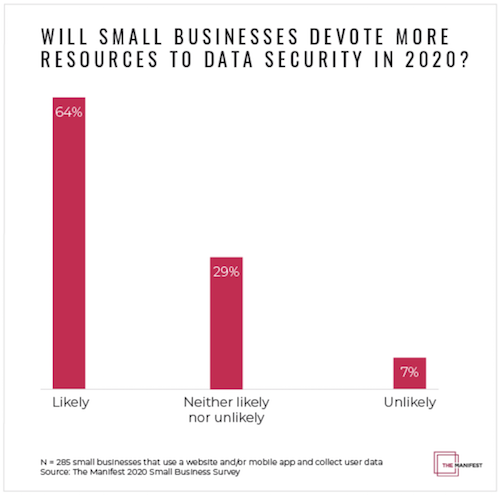
The Manifest found, at the time of data collection in December 2019, most small businesses (64 percent) said they were planning to devote more resources to cybersecurity in 2020.
The sudden economic downturn caused by the COVID-19 pandemic may mean small businesses can’t follow through with cybersecurity improvement plans, though, just as cybersecurity becomes more important than ever due to many businesses moving online and employees working remotely.
Small businesses can potentially seek out cost-effective solutions to cybersecurity, however, including simply limiting employee access to certain data and requiring strong passwords.
The most popular strategies small businesses pursue for cybersecurity are limiting employee access to data (46 percent) and encrypting data (44 percent), followed by requiring strong passwords (34 percent) and training employees on data safety (34 percent).
Limiting employee access reduces the touchpoints through which data can accidentally or intentionally suffer exposure. Meanwhile, encryption provides a safety net even if employees who have access find their devices stolen or exposed.
Source: Manifest
One of the best long-term solutions for cybersecurity, though, is regularly keeping employees trained on cybersecurity best practices.
“The top cybersecurity threat to small businesses is an insider threat because employees let cybercriminals in,” said Cyrus Walker, principal at Data Defenders, a cybersecurity services provider.
Click here for the full report.