
Having said that, privacy on the smartphone is now possible, as is shown by the Privacy Friendly Apps (PFAs) for Android.
Working with students, the SECUSO research group of Karlsruhe Institute of Technology (KIT) developed more than 30 apps for Android phones. They request authorizations required for functioning only and do not contain any tracking mechanisms. For these PFAs, SECUSO has now been granted the first Digital Autonomy Award by the Digital Autonomy Hub funded by the Federal Ministry of Education and Research.
Access to these highly sensitive data is subject to authorizations. For example, any app accessing the camera needs the respective authorization. During installation or in other contexts, however, many apps request authorizations to access private smartphone data, although this is not required for their functioning. Some weather apps or QR code scanners, for instance, request access to the address book or to private photos.

In addition, many apps contain trackers that continuously collect data, analyze the user behavior, and create profiles of persons without them being aware of it. The data collected can end up used for targeted advertising, but may also be stolen by hackers.
The PFAs developed by SECUSO (Security – Usability – Society) guarantee more privacy. The research group headed by Professor Melanie Volkamer is affiliated to KIT’s Institute of Applied Informatics and Formal Description Methods.
Students were and are significantly involved in the development of PFAs suited for Android smartphones.
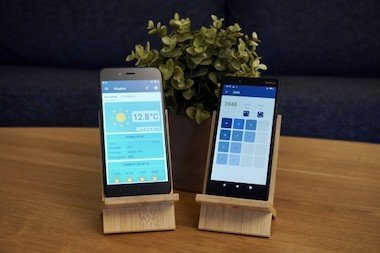
Weather forecasts or games also work when the principle of data minimization is observed, an example being PFAs.
Source: SECUSO research group of Karlsruhe Institute of Technology
“Through programming exercises or graduation theses, students come to know security and privacy aspects of Android app development,” Volkamer said. “Still, the challenge is to combine app development with academic education. Students without the relevant experience should also be able to take part.”
The PFAs only request the authorizations required for functioning, do not contain any tracking mechanisms, and, hence, do not collect any usage data.
“The data collected are stored locally on the smartphone,” said Christopher Beckmann, member of the SECUSO research group and responsible for the Privacy Friendly Apps Lab. “Clearly defined data will be transmitted to third providers only, if this is absolutely necessary for functioning.” The source code of every PFA is published on the GitHub platform.
Currently, more than 30 PFAs are offered in the areas of tools, fitness and health, games, and security, including a flashlight, to-do-list, pedometer, active break, sudoku, mental arithmetic trainer, password generator, and WiFi manager.
SECUSO wants to continuously further develop the PFAs and to expand the group of users.