
Mobile devices, including phones, smartwatches and fitness trackers, constantly transmit signals, known as Bluetooth beacons, at the rate of roughly 500 beacons per minute. These beacons enable features like Apple’s “Find My” lost device tracking service; COVID-19 tracing apps; and connect smartphones to other devices such as wireless earphones.
Prior research has shown that wireless fingerprinting exists in WiFi and other wireless technologies. The critical insight from the team at University of California San Diego was this form of tracking can also be done with Bluetooth, in a highly accurate manner.
Unique Imperfections
All wireless devices have small manufacturing imperfections in the hardware unique to each device. These fingerprints are an accidental byproduct of the manufacturing process. These imperfections in Bluetooth hardware result in unique distortions, which can end up used as a fingerprint to track a specific device. For Bluetooth, this would allow an attacker to circumvent anti-tracking techniques such as constantly changing the address a mobile device uses to connect to Internet networks.

Tracking individual devices via Bluetooth is not straightforward. Prior fingerprinting techniques built for WiFi rely on the fact WiFi signals include a long known sequence, called the preamble. But preambles for Bluetooth beacon signals are extremely short.
“The short duration gives an inaccurate fingerprint, making prior techniques not useful for Bluetooth tracking,” said Hadi Givehchian, also a UC San Diego computer science Ph.D. student and a lead author on the paper.
Instead, the researchers designed a new method that doesn’t rely on the preamble but looks at the whole Bluetooth signal. They developed an algorithm that estimates two different values found in Bluetooth signals. These values vary based on the defects in the Bluetooth hardware, giving researchers the device’s unique fingerprint.
The researchers evaluated their tracking method through several real-world experiments.
Found in Coffee Shops
In the first experiment, they found 40 percent of 162 mobile devices seen in public areas, for example coffee shops, were uniquely identifiable. Next, they scaled up the experiment and observed 647 mobile devices in a public hallway across two days. The team found 47 percent of these devices had unique fingerprints. Finally, the researchers demonstrated an actual tracking attack by fingerprinting and following a mobile device owned by a study volunteer as they walked in and out of their house.
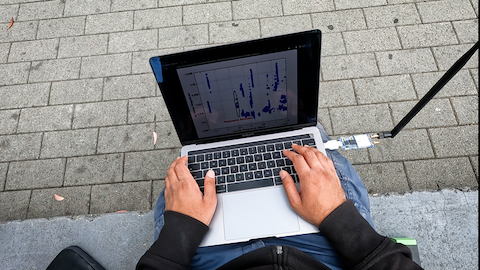
Researchers tested their method to track Bluetooth fingerprints on campus. They use an off-the-shelf device to track and identify devices.
Source: University of California San Diego
Although their finding is concerning, the researchers also discovered several challenges an attacker will face in practice. Changes in ambient temperature for example, can alter the Bluetooth fingerprint. Certain devices also send Bluetooth signals with different degrees of power, and this affects the distance at which these devices can be tracked.
Researchers also note their method requires an attacker to have a high degree of expertise, so it is unlikely to be a widespread threat to the public today.
Despite the challenges, the researchers found Bluetooth tracking is likely feasible for a large number of devices. It also does not require sophisticated equipment: the attack can end up performed with equipment that costs less than $200.
To fix the issue, Bluetooth hardware would have to be redesigned and replaced. But the researchers believe other, easier solutions can be found. The team is currently working on a way to hide the Bluetooth fingerprints via digital signal processing in the Bluetooth device firmware.
Researchers are also exploring whether the method they developed could be applied to other types of devices.
Building Defenses
“Every form of communication today is wireless, and at risk,” said Dinesh Bharadia, a professor in the UC San Diego Department of Electrical and Computer Engineering and one of the paper’s senior authors. “We are working to build hardware-level defenses to potential attacks.”
Researchers noticed just disabling Bluetooth may not necessarily stop all phones from emitting Bluetooth beacons. For example, beacons are still emitted when turning off Bluetooth from the control center on the home screen of some Apple devices. “As far as we know, the only thing that definitely stops Bluetooth beacons is turning off your phone,” Bhaskar said.
Researchers are careful to say even though they can track individual devices, they are not able to obtain any information about the devices’ owners. The study was reviewed by the campus’ Internal Review Board and campus counsel.
“It’s really the devices that are under scrutiny,” said Aaron Schulman, a UC San Diego computer science professor and one of the paper’s senior authors.