
Concrete is the most widely used building material in the world and efforts to improve concrete strength have led to reports of porosity-free concrete (PFC), the hardest concrete tested to date.
Ultra-high-strength concrete offers significant advantages including reducing the weight of large structures and protecting them against natural disasters and accidental impacts. PFC is an ultra-high-strength concrete whose properties can further end up enhanced by incorporating steel fibers.
The way in which PFC ends up prepared leads to very few voids in the final material, which gives it its high strength– 400 MPa can end up applied to PFC before it fails, compared with 20-30 MPa for standard concrete.
Reports about some of the basic material properties of steel fiber-reinforced PFC have already come out; now a research team including Kanazawa University evaluated the impact response of a range of PFC preparations with different steel fiber contents and section heights.

“The continued development of building materials is particularly important in areas where frequent natural disasters threaten the integrity of structures,” said Yusuke Kurihashi, associate professor at Kanawaza University and lead author of a study on the subject. “We carried out impact tests on a variety of steel fiber-reinforced PFC samples to determine their reactions, and in so doing, accelerate the widespread application of PFC in building projects. Our testing is designed to simulate responses to events such as rock falls, blasts and flying objects.”
The researchers made two key findings.
First, they observed increasing the steel fiber content from 1 percent to 2 percent reduced the damage due to the impact by 30 percent to 50 percent. This significant improvement in performance could help inform future material design decisions.
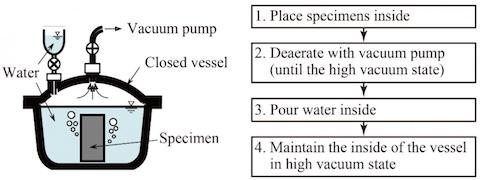
Outline of degassing and water absorption treatment. PFC specimens then end up placed in a closed vessel depressurized using a vacuum pump, and water introduced from the outer surface to the inside.
Source: Kanazawa University
In addition, they showed it was possible to predict the behavior of the samples with approximately 80 percent accuracy by comparing calculated values with those already measured, which will help to streamline development processes.
“We hope that PFC will contribute to enhanced building safety in the future,” Kurihashi said. “Although additional experimental work and statistical processing is required to fully translate PFC into widespread practical applications, our findings make a significant contribution to understanding PFC’s role in improving the safety of many large structures including high-rise buildings, bridges and roads.”