
A supercapacitor can be efficiently manufactured into a high-performance and low-cost power storage device that can end up easily integrated into footwear, clothing, and accessories, said researchers from the University of Surrey’s Advanced Technology Institute (ATI) and the Federal University of Pelotas (UFPel), Brazil, who wrote a paper on the subject.
“Supercapacitors are key to ensuring that 5G and 6G technologies reach their full potential,” said Professor Ravi Silva, director of the ATI and head of the Nano-Electronics Centre at the University of Surrey.
A supercapacitor is a means to store and release electricity, like a typical battery, but it does so with far quicker recharging and discharging times.

In the paper, the research team describe a new procedure for the development of flexible supercapacitors based on carbon nanomaterials. This method, which is cheaper and less time-consuming to fabricate, involves transferring aligned carbon nanotube (CNT) arrays from a silicon wafer to a polydimethylsiloxane (PDMS) matrix. This is then coated in a material called polyaniline (PANI), which stores energy through a mechanism known as “pseudocapacitance,” offering outstanding energy storage properties with exceptional mechanical integrity.
The team’s enhanced, wafer-thin supercapacitor retains most of its capacitance (the amount of separate electric charge that can be stored) after numerous cycles at different bending conditions, demonstrating its robustness, longevity, and efficiency.
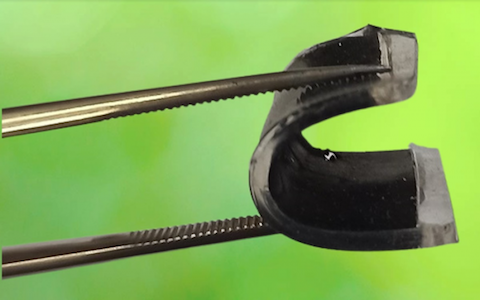
Tongs bend a supercapacitor into a U shape, which can be efficiently manufactured into a high-performance and low-cost power storage device.
Source: University of Surrey
This work is another output from the long, ongoing international collaborations between the ATI, led by Professor Ravi Silva, and Brazilian higher education institutions. The initial research work was carried out in the ATI and consisted of the growth and characterization of materials, followed by electrochemical measurements carried out at the UFPel by Raphael Balboni (lead author and Ph.D. student) and others from the NOVONANO group led by Professor Neftali Carreño.
“Working at the ATI on a project of that could have a positive impact on industry and our environment has been incredibly fulfilling,” Balboni said. “My supervisor, Professor Silva, and the entire team at Surrey made me feel like a valuable member of the team and I was lucky enough to learn from outstanding colleagues. This is an experience that I will never forget.”
Click here for some information on the paper.