
However, traditional security methods struggle to cope with these attacks due to the limited computational power of IoT devices and the dynamic nature of cyber threats.
Anomaly-based intrusion detection systems, which identify deviations from normal behavior, emerged as a promising solution. However, these systems often face challenges such as high computational costs and an increased rate of false positives. This calls for the development of more efficient, scalable, and accurate IDS tailored specifically for the unique constraints and challenges of IoT environments.
The system, tested on the RT_IoT2022 dataset, demonstrated exceptional accuracy in detecting and classifying IoT intrusions. CatBoost emerged as the leading model, achieving 99.85 percent accuracy, setting a new benchmark in IoT security.

The study underscores the potential of bio-inspired algorithms like PSO to enhance the efficiency and effectiveness of cybersecurity solutions in resource-constrained IoT networks.
Hybrid Approach
The study’s innovation lies in its hybrid approach, where PSO optimizes feature selection, reducing computational overhead while maintaining high accuracy.
Six models – SVM, KNN, CatBoost, Naïve Bayes, CNN, and LSTM – ended up evaluated, with CatBoost excelling in both binary classification (99.85 percent accuracy) and multiclass classification (99.82 percent), outperforming other methods such as QAE-f16 by 2.6 percent.
The RT_IoT2022 dataset, which includes real-world attack scenarios like ARP poisoning and DDoS, served as a robust testing ground. Notably, PSO helped reduce SVM training time by 23x with minimal loss in accuracy, addressing the resource limitations of IoT devices. However, challenges remain, such as misclassifying rare attacks like NMAP FIN scans due to dataset imbalance, highlighting areas for future refinement.
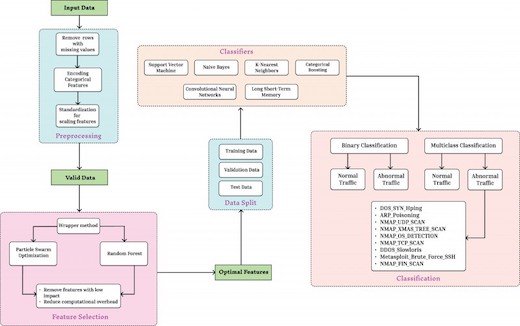
Flowchart of the proposed framework.
Source: Data Science and Management
“Our PSO-enhanced framework not only achieves unprecedented accuracy but also optimizes resource usage, making it practical for real-world IoT deployments,” said Dr. Mourad Benmalek, the study’s corresponding author and assistant professor of cybersecurity at Al Yamamah University. “CatBoost’s outstanding performance showcases the potential of gradient boosting in cybersecurity, while PSO’s efficiency opens doors for lightweight IDS solutions that are ideal for IoT environments with limited resources.”
The implications of this IDS framework are vast, extending across industries reliant on IoT, including healthcare, smart grids, and industrial automation.
Minimizing False Positives
By minimizing false positives and computational costs, the system enables scalable, real-time threat detection, which is crucial for industries that rely on continuous, uninterrupted service.
Organizations can enhance regulatory compliance, safeguard sensitive data, and build customer trust through robust cybersecurity measures.
Future research may focus on exploring hybrid models and improving real-time adaptability, further enhancing IoT defenses against evolving threats. This study sets a new benchmark for ML/DL applications in cybersecurity, providing a vital step toward stronger IoT protection in the face of increasingly sophisticated cyberattacks.