
Taking that thought by studying the arts and using a model of violin synchronization in a network of violin players, there are ways to drown out distractions and miscommunications that could end up used as a model for human networks.
Along those lines, a research team from Stony Brook University in New York devised an experiment involving 16 violinists with electric violins connected to a computer system. Each of the violinists had sound-canceling headphones, hearing only the sound received from the computer. All violinists played a simple repeating musical phrase and tried to synchronize with other violinists according to what they heard in their headphones.
Research on network links or coupling has focused predominantly on all-to-do coupling, whereas current social networks and human interactions are often based on complex coupling configurations, said Shniderman, Weymouth and their fellow authors.

This study of synchronization between violin players in complex networks with full control over network connectivity, coupling strength and delay, revealed players can tune their playing period and delete connections by ignoring frustrating signals to find a stable solution. These controlled and new degrees of freedom enable new strategies and yield better solutions potentially applicable for other human networking models.”
“Society in its complexity is recognizing how human networks affect a broad range of crucial issues, including economic inequality, stock market crashes, political polarization and the spread of disease,” Weymouth said. “We believe there are a lot of important, real-world applications to the results of this experiment and ongoing work.”
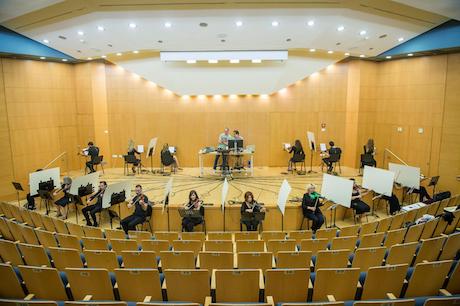
Sixteen violinists participating in the networking experiment in which they are connected to a computer system hearing only the sound received from the computer.
Source: Chen Damari