
In this type of attack, two adversaries relay the short-range communication over a long-range communication channel.
Research conducted by the COSIC Research Group at Ku Leuven, a research university in Leuven in Flanders, Belgium, evaluated the resistance of a modern-day PKES system to attacks other than relay attacks.
The PKES system grants the ability to unlock and start the car if the key fob is in proximity.

The PKES system the researchers analyzed used a simple challenge response protocol. The car uses the Low Frequency (LF) band at 134.2 kHz for transmission. The key fob on the other hand transmits in the Ultra High Frequency (UHF) band at 433.92 MHz in Europe.
During normal operation the car periodically advertises its identifier. The key will receive the car’s identifier, if it ends up being the expected car identifier, the key fob will reply, signaling it is ready to receive a challenge.
In the next step the car will transmit a random challenge to the key fob. The key fob computes a response and transmits it. After receiving the key fob’s response, the car must verify it before unlocking the doors. The same challenge response protocol is repeated to start the car.
The simple challenge-response protocol described earlier does have some issues. For example, the lack of mutual authentication allows anyone who knows the car’s identifier to get responses from a key fob. This identifier broadcasted by the vehicle in the wake messages and can end up recorded by anyone.
An even graver security issue lies in the cryptographic primitive used for computing responses, the researchers said in a blog post. This system is using the outdated proprietary cipher DST40. Back in 2005, Bono et. al. reverse engineered this cipher using a black box approach and exhaustively searched the 40-bit key using an FPGA cluster.
As shown in a video, the attack is carried out in multiple phases:
- Phase 0: The adversary records one wake frame periodically transmitted by the car to learn the 2-byte car identifier.
- Phase 1: The adversary can now impersonate the car and transmits two chosen 40-bit challenges to the key fob and records their respective 24-bit responses.
- Phase 2: Using the captured challenge response pairs and the TMTO table the 40-bit key can be recovered. The first pair is used to select the correct subset of keys and the second pair is used to find the real key among the approximately 216 candidate keys.
- Phase 3: The adversary can now impersonate the key fob and thus unlock and start the car.
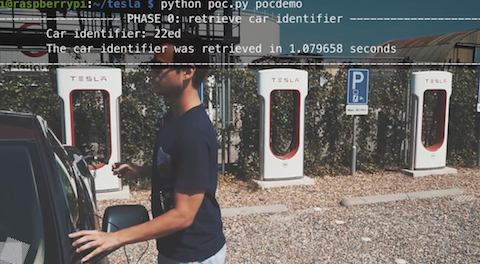
Researchers show it is possible to hack into a high-end vehicle and drive away.Source: COSIC research group at Ku Leuven
In terms of what vehicles are vulnerable to this attacker, the researchers only verified the attack on a Tesla Model S. However, Tesla did not design this system themselves but purchased it from Pektron. According to the Federal Communication Commission (FCC) equipment authorization database, Pektron also designed keyless entry solutions for manufacturers such as McLaren, Karma and Triumph. The internal pictures included in the FCC database show that all these systems use the same Texas Instruments TMS37F128 chip, the researchers said. That led them to believe the attack also affects the other manufacturers.
In terms of mitigations for this type of attacker, it is often recommended to place the key fob in a Faraday bag or metal box to block the RF transmissions. While this could be an effective countermeasure, it is far from convenient.
Tesla introduced some software features that could help hinder an adversary. Tesla Model S owners should disable passive entry and enable the pin to drive feature.
A third option is to modify the key fob by adding an extra push button which only enables the low frequency communication when pressed. The advantage of this modification is it stops relay attacks and it makes a key fob cloning attack harder to execute in practice. This countermeasure might be your only option if you own one of the affected vehicles that did not introduce software countermeasures.