
BESS fires can start from thermal runaway, where one cell failure can trigger a cascade of overheating, leading to fires that are difficult to extinguish and can last for hours or even days.
Additionally, if there was a fire, hazardous gases would release from the batteries, posing health risks to nearby communities and causing environmental damage through soil and water contamination. In severe cases, BESS fires have the potential for huge disruptions to local businesses and residents through property damage and potential evacuations.
Thermal cameras detect heat signature from the onset of thermal runaway long before visible flames or smoke appear, allowing for preemptive action to mitigate risks. While flame detectors react to events that already happened, a fixed thermal camera such as the FLIR A700F Advance Smart Sensor provides 24/7 surveillance by continuously monitoring for temperature anomalies that could indicate an impending fire, thus enabling early intervention.

Automated Response
FLIR cameras end up designed for easy integration into broader safety and control systems, allowing for automated responses such as activating suppression systems that enhance response times and efficiency.
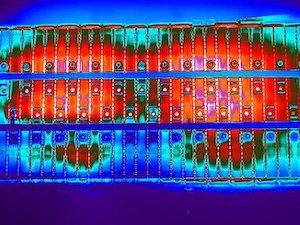
Lithium-ion electric vehicle batteries monitored under thermal imaging.
Source: FLIR
While the design of flame detectors are to detect visible fire, they may miss smoldering or hidden fires, meaning an alert may not trip until the fire has escalated to a dangerous level.
FLIR thermal imaging cameras can detect heat in low light and see the beginnings of embers as they heat up surrounding materials, even when there’s no visible sign of fire. This early detection can prevent escalation or at least minimize damage by providing critical time for action before fires get out of control.
Another advantage of thermal cameras is their ability to monitor large areas or multiple battery racks simultaneously, providing comprehensive coverage which is often challenging for point-specific flame detectors.