
About 50 cars, including 10 carrying hazardous materials, derailed in a fiery crash Friday in East Palestine, said rail operator Norfolk Southern and the National Transportation Safety Board. Vinyl chloride was slowly releasing into the air Monday from five of those cars before crews decided to ignite it and burn off the highly flammable, toxic chemicals in a controlled environment, creating a dark plume of smoke.
Vinyl chloride gas is used to make the polyvinyl chloride hard plastic resin in plastic products. It is found in products such as credit cards, furniture and car parts, but is most notably used in PVC plastic piping, a common material for plumbing.

Vinyl chloride is associated with increased risk of liver cancer and other cancers, according to the federal government’s National Cancer Institute.
Vinyl chloride is dozens of times less toxic per molecule than the U.S.-banned insecticide DDT but more dangerous per part than ammonia and natural gas, according to federal regulations that dictate acceptable levels in the air.
Officials warned the controlled burn would send phosgene and hydrogen chloride into the air. Phosgene is a highly toxic, colorless gas with a strong odor that can cause vomiting and breathing trouble and was used as a weapon in World War I.
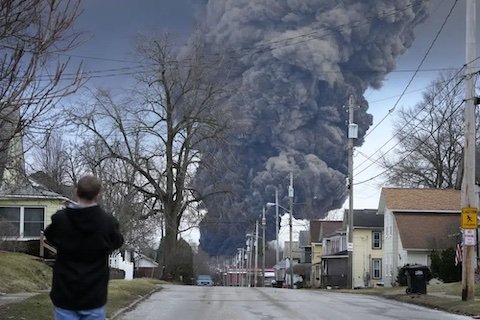
A plume of smoke rises from a Norfolk Southern train that derailed Friday in East Palestine, Ohio. Officials decided to conduct a controlled burn of the toxic chemicals after evacuating nearby residents.
Source: AP Photo/Gene J. Puskar
Phosgene is considered safe at 0.1 parts per million during an eight-hour exposure, or 0.2 ppm for a 15-minute exposure. The eight-hour exposure threshold would have to be even lower when measuring inside people’s homes, where residents often spend more than eight consecutive hours.
Hydrogen chloride is a colorless to yellowish gas with a strong odor and its primarily effect on humans is skin, eye, nose and throat irritation. It is considered safe at 5 ppm for an eight-hour exposure.