
When operating a tactical communications network, there is always the potential of a sophisticated adversary being able to detect transmissions.
Knowing that, an analysis framework is now in development that enables the ability to study the detectability of ultraviolet communication systems, which should be able to provide insights to secure networks in the future, said Army researchers.
In particular, ultraviolet communication has propagation characteristics that not only allow for a novel non-line-of-sight optical link, but also imply the transmissions may be harder for an adversary to detect.
Building off of experimentally validated channel modeling, channel simulations, and detection and estimation theory, the developed framework enables the evaluation of tradeoffs associated with different design choices and the manner of operation of ultraviolet communication systems, said Dr. Robert Drost of the U.S. Army Combat Capabilities Development Command’s Army Research Laboratory.

Detection Probabilities
“While many techniques have been proposed to decrease the detectability of conventional radio-frequency, or RF, communications, the increased atmospheric absorption of deep-ultraviolet wavelengths implies that ultraviolet communication, or UVC, has a natural low-probability-of-detection, or LPD, characteristic,” Drost said. “In order to fully take advantage of this characteristic, a rigorous understanding of the LPD properties of UVC is needed.”
In particular, Drost said, such understanding is essential for optimizing the design and operation of UVC systems and networks and for predicting the quality of the LPD property in a given scenario, such as using UVC to securely network a command post that has an estimate of the direction and distance to the adversary.
Without such a predictive capability, he said, users would lack the guidance needed to know the extent and limit of their detectability, and this lack of awareness would substantially limit the usefulness of the LPD capability.
The researchers, including Drs. Mike Weisman, Fikadu Dagefu, Terrence Moore and Drost from CCDC ARL and Dr. Hakan Arlsan, Oak Ridge Associated Universities postdoctoral fellow at the lab, demonstrated this by applying their framework to produce key insights regarding the LPD characteristics of UVC, including:
- LPD capability is relatively insensitive to a number of system and channel properties, which is important for the robustness of the LPD property
- Adversarial line-of-sight detection of a non-line-of-sight communication link is not as significant of a concern as one might fear
- Perhaps counter to intuition, steering of a UVC transmitter does not appear to be an effective detection-mitigation strategy in many cases
- Line-of-sight UVC link provides non-line-of-sight standoff distances commensurate with the communication range
Prior modeling and experimental research demonstrated UVC signals attenuate dramatically at long distance, leading to the hypothesis UVC has a fundamental LPD property, Drost said. However, there has been little effort on rigorously and precisely quantifying this property in terms of the detectability of a communication signal.
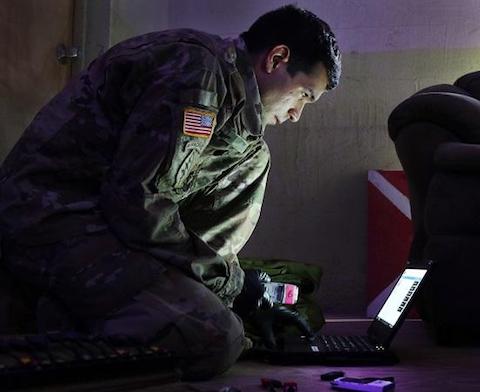
An analysis framework that enables the rigorous study of the detectability of ultraviolet communication systems is under development which should provide insights to deliver more secure Army networks.
Source: K. Kassens
“Our work provides a framework enabling the study of the fundamental limits of detectability for an ultraviolet communication system meeting desired communication performance requirements,” Drost said.
Novel Communications Capabilities
Although this research is focused on longer-term applications, he said, it is addressing the Army Modernization Priority on Networks by developing the fundamental understanding of a novel communications capability, with a goal of providing the soldier with network connectivity despite challenging environments that include adversarial activity.
“The future communications and networking challenges that the Army faces are immense, and it is essential that we explore all possible means to overcoming those challenges,” Drost said. “Our research is ensuring that the community has the fundamental understanding of the potential for and limitations of using ultraviolet wavelengths for communications, and I am confident that this understanding will inform the development of future Army networking capabilities. Conducting fundamental research that impacts decision making and Army technologies is why we work for the Army, and it is very satisfying to know that our work will ultimately support the warfighter in his or her mission.”
The researchers are currently continuing to develop refined understanding of how best to design and operate ultraviolet communications, and an important next step is the application of this framework to understand the detectability of a network of ultraviolet communications systems.