
With the increase in connectivity across the industrial manufacturing segment, an unreal amount of data will end up processed in order to fine-tune performance, deliver analytics on key services, and ensure the integrity of critical industrial, healthcare, and enterprise processes, said researchers in security provider Claroty’s fourth Biannual ICS Risk & Vulnerability Report. The report was prepared by Claroty’s research arm, Team82.
On top of those trends, vulnerabilities across industrial control systems (ICS) flourished in the second half (2H) of 2021 by growing 25 perce nt as attacks on cyber-physical systems become more advanced and pervasive, the researchers said. Attackers are better at exploiting weaknesses and as a result, securing beyond operational technology (OT) to the Extended Internet of Things (XIoT) is paramount.
The report also found 87 percent of vulnerabilities are low complexity, meaning they don’t require special conditions and an attacker can expect repeatable success every time.

Increased Connectivity
As mentioned, XIoT is one of the trends security folks should look at in the coming months. XIoT is an umbrella term that captures the cyber-physical systems critical to our lives. Connected devices, operational technology, healthcare systems are rapidly connecting online and to the cloud, not only for security management, but for data analysis, performance tracking and enhancement.
Those efficiencies are appealing to businesses, which makes it the job of security professionals to ensure they remain secure.
Exploit a vulnerability in the cloud and you have access to all the accounts and devices it manages, according to the report. An attacker could then execute exploits to run code on devices managed from the cloud, which enables not only full control of an endpoint device, but also lateral network movement and a greater array of payloads at their disposal. Team82 has shown it’s possible to exploit a vulnerability in a device such as a cloud-managed PLC and eventually take over the cloud-based host account.
These types of top-down, bottom-up attacks are novel, and have been demonstrated as effective. They threaten process integrity by putting field devices such as PLCs at risk, and they also threaten data integrity and whether organizations can trust the data uploads devices are sending back to the cloud.
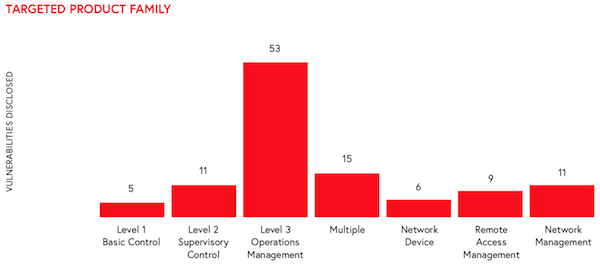
Breakdown of vulnerabilities discovered by Team82 by product family type.
Source: Team 82
Managers overseeing converged XIoT environments must consider a range of potential weaknesses and how they can be exploited remotely or locally, according to the report. The security of third-party partners such as vendors and suppliers must also be managed; a compromised vendor with access to sensitive systems is essentially a backdoor to cloud-managed systems. Multi-tenant hosts are also a risk to cloud-based XIoT systems. An attacker with access to the host system managed by a service provider would theoretically be able to target any of the virtual instances on that host, creating a single point of failure.
Supply Chain Attacks
Securing the supply chain is another vital area to secure. While SolarWinds was a jolt to technology owners and operators in early 2021, the critical vulnerability in Log4j disclosed in December demonstrated how fragile the software supply chain is, and how exploitable vulnerabilities in an open source component can put thousands of companies and users at risk in an instant, the researchers said.
Log4j, a popular open source Apache logging framework, contained a remote code execution flaw that was trivial to exploit; Log4j is used by more than 2,000 companies, the Apache Software Foundation said. A malicious string that is logged by an application using Log4j triggers a JNDI (Java Naming and Directory Interface) lookup that would connect to an attacker-controlled server and load malicious Java code.
Automation vendors use Log4j as a component across the OT domain putting numerous industrial processes at risk, the researchers said. While Log4j was quickly patched, equally as important were the resulting discussions about the software supply chain, and ensuring the secure use of open source components within critical infrastructure.
Another trend to watch is something that has been around for a long time, and that is ransomware.
Ransomware and extortion attacks never seem to subside, and for good reason: They work.
Ransomware Triple Threat
The thought of a ransomware attack gives asset owners and operators plenty to consider when it comes to risk assessments. The triple threat of locking up a system and holding it for ransom or it will be released to the public and then reaching out to customers saying their information will end up release of the victim does not pay is a growing trend.
Along those lines, a Claroty survey found 80 percent of critical infrastructure has been attacked by ransomware, and 60 percent have paid ransoms. While the second half of 2021 lacked a dramatic major incident, the first six months of the year demonstrated to threat actors that critical infrastructure and OT assets run on vulnerable IT technology that can be targeted to impact critical processes and services.
Incidents at Colonial Pipeline, JBS, and NEW Cooperative, just to mention a few, were largely profit-motivated attacks where cybercrime operators researched and understood their victims’ willingness to pay hefty ransoms, according to the report. In each case, attackers demanded millions of dollars in return for restored systems, and Colonial and JBS did reportedly adhere to their attackers’ demands.
In 2022, asset owners and operators should be aware of these types of nation-state tactics, and how kinetic conflicts can also spill online, the researchers said. As conflicts escalate, users should have adequate threat intelligence in order to keep abreast of tactics, techniques, and procedures used to target their infrastructure. Tightening firewall rules, blocking webmail to counter phishing attacks, backing up regularly, storing backup files offline and off-site, and securing OT project files are key strategies to remember as geopolitics enters cyberspace.
Click here for more on the report.