
Additionally, in those cyberattacks across the U.S. and UK, 62 percent of utility operators ended up targeted over the past year, and of those, 80 percent ended up attacked multiple times, according to the report from Semperis, an AI-powered identity security and cyber resilience provider.
High-profile cyberattacks by nation-state groups on water and electricity utilities underscore the vulnerability of critical infrastructure. A public utility in Littleton, MA, ended up compromised by a group linked to Volt Typhoon, the Chinese state-sponsored threat group.
Moreover, more than one-third (38 percent) of utility operators believed they had not suffered a cyberattack. Cybersecurity experts view this figure as alarmingly high, suggesting many of these organizations may have been breached without realizing it.

“Many public utilities likely don’t realize that China has infiltrated their infrastructure,” said Chris Inglis, the first U.S. National Cyber Director and Semperis Strategic Advisor. “Chinese-sponsored threat actors like Volt Typhoon are known to prefer Living off the Land attacks, which are difficult to detect and can remain dormant, planting backdoors, gathering information, or waiting to strike for months or even years.”
Active Directory Eyed
The report, “The State of Critical Infrastructure Resilience: Evaluating Cyber Threats to Water and Electric Utilities,” found nearly 60 percent of attacks ended up carried out by nation-state groups. In addition, in 81 percent of cyberattacks, attackers compromised identity systems such as Active Directory, Entra ID, and Okta.
Additionally, the potential public impacts of being without electricity, heat, or clean water for even a short period can be significant.
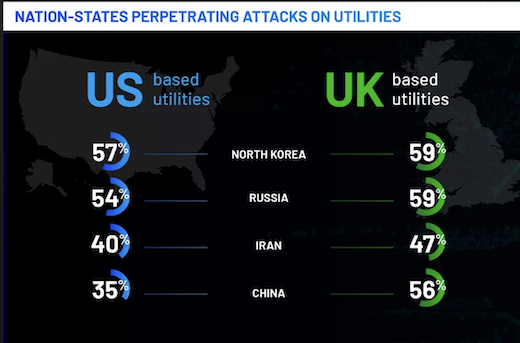
Countries behind the water and electric utility attacks against the United States and UK.Source: Semperis
“If you don’t improve resilience, attackers keep coming. Utilities have an opportunity to address this challenge,” said Mickey Bresman, chief executive at Semperis. “They need to assume breaches will happen and, through tabletop exercises, they can practice attack scenarios that could be a reality in the future.”
Moreover, what sets utility operators apart from other industries is the critical nature of their work. If an electricity or water operator ends up compromised, the potential risks to public health and safety can put an entire nation at risk. Furthermore, researchers noted resilience to cyberattacks that threaten operations should be the top priority for every organization involved in critical infrastructure.
To improve operational resilience against cyberattacks, utilities should:
- Identify Tier 0 infrastructure components essential for recovery from a cyberattack.
- Prioritize incident response and recovery for these systems, followed by mission-critical (Tier 1) functions, business-critical (Tier 2) functions, and then all other (Tier 3) functions.
- Document response and recovery processes and practice them using real-world scenarios that involve people and processes beyond the IT department.
- Focus not just on fast recovery but on secure recovery. Attackers often attempt to compromise backups to maintain persistence in the environment, even after recovery attempts. Implement solutions that support speed, security, and visibility in crisis situations.