
By Gregory Hale
The water industry is so important and key to everyday life, but yet, it ends up being taken for granted and ends up overlooked which means security is often weak at best.
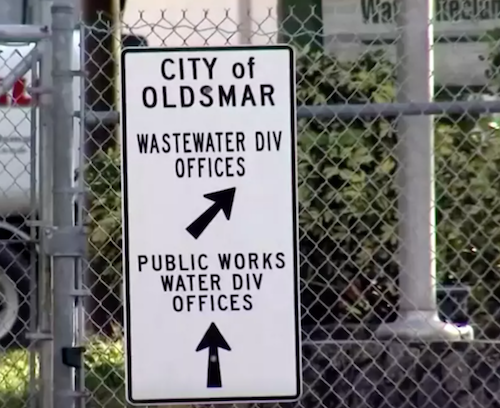
That is why the Friday attack on the city of Oldsmar, Florida’s water supply, where someone remotely accessed a computer for the city’s water treatment system and briefly increased the amount of sodium hydroxide, or lye, by a factor of more than 100, from 100 parts per million to 11,100 parts per million.
Thanks to an operator who witnessed the attack going on, he was able to quickly change the setting back to 100 parts per million.
Sodium hydroxide is used in small amounts to control the acidity of water but it’s also a corrosive compound commonly found in household cleaning supplies such as liquid drain cleaners. Contact with sodium hydroxide can kill skin and cause hair loss, according to the National Center for Biotechnology Information. Ingestion can be fatal.

Supply Not Affected
In short, thanks to some quick thinking workers, the city’s water supply was not affected. In the incident, a supervisor working remotely saw the concentration being changed on his computer screen and immediately reverted it, said Pinellas County Sheriff Bob Gualtieri in a news conference.
Other safeguards were in place to prevent contaminated water from entering the water supply. Oldsmar provides water directly to its businesses and 15,000 residents, Gualtieri said. The computer system at the water treatment plant was set up to allow authorized users to remotely access it for troubleshooting.
While the plant operator was monitoring the system at 8 a.m. Friday and noticed that someone briefly accessed it. He didn’t find this unusual, Gualtieri said, because his supervisor remotely accessed the system regularly.
But at 1:30 p.m. the same day, Gualtieri said, someone accessed the system again. This time, he said, the operator watched as someone took control of the mouse, directed it to the software that controls water treatment, worked inside it for three to five minutes and increased the amount of sodium hydroxide from 100 parts per million to 11,100 parts per million. The attacker left the system, Gualtieri said, and the operator immediately changed the concentration back to 100 parts per million.
Vulnerable Utilities
The issue is how vulnerable are the small water utilities and will this be a wake up call for them – and the other small organizations in the manufacturing automation sector – to become more cognizant of security.
“The water industry is vital to this and any country, but often it is overlooked, underfunded and running on decades old equipment,” said Graham Speake, senior security manager at Accenture Security. “Within a small area there is often multiple Municipal Utility Districts (MUD) each serving their designated properties. The main focus of the MUD is the supply and maintenance of the systems, and the IT resources are small or outsourced. While each MUD wants to be secure, it is probably not their top goal, which is of course safety of personnel and the water.
“Remote access for updates, and control of the systems is common place. These may well be designed and operated for ease rather than high security as operators want to quickly and easily remotely operate the systems. The remote access systems, often combined with default passwords on multiple pieces of equipment and control systems, can lead to a dangerous situation. The Oldmar attack has shown that more needs to be done to improve the security of water systems, and consequently the safety of the customers of the individual MUD,” Speake said.
“The U.S. water utility infrastructure, especially for the small utilities, is a mess,” said Eric Byres, chief executive at aDolus, a SaaS-based system provider that integrates machine learning and security to deliver a “trustworthiness” score for software. “They are not properly prepared from a security perspective.”
“We don’t make it easy for people to do the right thing. Government regulations have requirements for what you can and can’t do. We just don’t tell any here is how to do this properly.
Water Overlooked
“I am not surprised that we don’t have more incidents like this,” said Dewan Chowdhury, chief executive and founder of security provider, malcrawler. “Water is not as regulated compared to power utility, most water treatment facilities are managed at the municipal level, and their cybersecurity practices are minimal. Some non-regulatory bodies provide guidance to water treatment facilities to have a stronger cybersecurity posture, but nothing is regulatory. The same municipals are the ones that are constantly being victimized by ransomware. If they have a difficult time protecting their own IT enterprise network, how can they protect the industrial control environment? Cybersecurity companies, the “elite” intelligence community, etc, have all been hacked and humiliated. I don’t think the authorities did a great job protecting federal agencies or protecting large American businesses. How could a municipality protect a small water treatment facility?”
The incident highlights how big a risk this is with poorly designed remote access. And the thing is, remote access is not going away.
“You see this all the time where the supervisor js checking in remotely,” Byres said. “Here was a desperate tiny utility trying to get the most out of their staff who are trying to do their best operating 7/24 when they don’t have 7/24 staffing. They are water guys and not security guys.”
“Ultimately, they will have to get some money from ratepayers to analyze what they have to do,” Byres said. “For remote access there has to be clear guidelines on how to properly rollout remote access.”