
Once repairs to the diesel backup generator were completed, plans were made to disconnect from the rental generator and connect to the diesel backup generator.
The Person in Charge (PiC) and electrician walked down the job, verified the breaker’s proper open position, and conducted Lock-Out/Tag-Out (LO/TO) on the rental generator, according to an investigation with the Bureau of Safety and Environmental Enforcement (BSEE).
The electrician disconnected the rental generator cables and installed the first cable of the diesel backup generator.

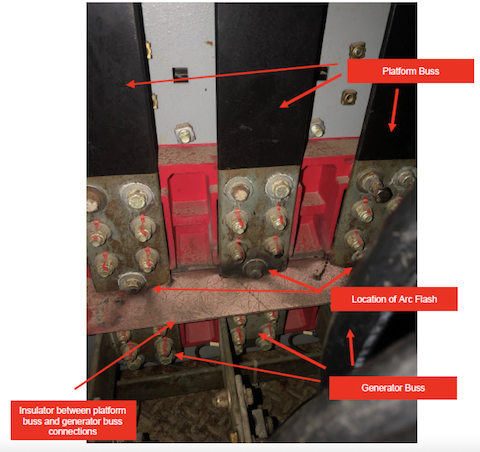
He then connected the next cable of the diesel backup to the bus. When the cable touched the attachment lug, an arc flash occurred, which caused the main natural gas generator to shut down.
Arc flash is a phenomenon where a flashover of electric current leaves its intended path and travels through the air from one conductor to another or to ground. As a result of the arc flash, the electrician received a second-degree burn to his arm. The job was stopped, and the electrician received treatment for his injury.
The BSEE investigation of the incident found:
- The electrician completed a Job Safety Analysis (JSA) for Daily Electrical Repairs but did not detail the work steps and hazards associated with disconnecting and reconnecting generator leads to a live bus.
- The potential hazard of an arc flash was not addressed; therefore, proper Personal Protective Equipment (PPE) to protect personnel from arc flash was not donned.
- The electrical cabinets where the cables connect did not have any markings to indicate an arc flash possibility.
- The LO/TO documents failed to indicate specific equipment being locked out.
The breaker for the diesel generator was a central safety element. This breaker is essential to allowing work to happen on a live bus.
An overview of the generator set up.
Source: BSEE
A third party analyzed the breaker as part of the investigation and their initial finding showed the following:
- Main trip unit failed primary injection test
- Damaged arc chutes
- High resistance in current path
- Damaged wiring
- Loose and missing hardware
- Breaker had a crack in pole base that could allow voltage to leak to ground.
As it turned out, the breaker could not be isolated as the primary cause of the arc flash event, but it was a contributing cause to this incident.
BSEE recommends operators and contractors consider the following:
- Conducting proper JSA review and hazard assessment prior to commencing jobs that involve voltages greater than 50V. An independent hazard review with engineering should be considered for electrical work that is conducted infrequently.
- Including arc flash as a safety topic and encouraging personnel participation by asking questions linked to identifying these hazards.
- Conducting an arc flash assessment at least annually to ensure proper hazards are understood by all personnel that may work on or near an arc flash hazard. The arc flash assessment should review hazard potential, signage, and PPE requirements. The assessment should also trigger specific steps to include in all supporting documents including LO/TO and JSA.
- Reviewing OSHA CFR 29 §1910.269 App E – Protection From Flames and Electric Arcs., and NFPA 70E – Standard for Electrical Safety in the
- Workplace, and making appropriate adjustments.
- Reviewing and verifying qualifications of all personnel working on equipment with exposed voltage to ensure competency in arc flash prevention and protection.
- Reviewing all breakers’ age and condition, especially before work that involves disconnecting and reconnecting leads of higher voltage equipment. The breakers are often run-to-failure elements, but the failure has dire consequences.
Much of the arc-flash hazard can be mitigated by the additional use of “current-limiting” fuses in series with the circuit breakers which serve as the primary over-current protective devices. The fuses can be selected based on circuit dynamics to not open during transient brief overload conditions such as starting of large motors but act as Short-Circuit protection limiting that energy to very manageable levels where danger zone is only six inches from part.
Procedures only work when followed and they tend to by the wayside over the long haul when people change, and levels of training are forgotten. Circuit breaker’s mechanical linkages tend to not work as fast when in service for long extended periods without refurbishing or cycling. Fuses only fail one way, conservatively and there’s no mechanical linkages to freeze up.
The US NEC has been requiring arc-flash warning labels on such equipment for years now. NFPA 70E gives recommended default PPE required for typical situations where the circuit analysis showing otherwise wasn’t performed. I didn’t see any mention of filed labels (signage maybe?) in the recommendations.