
The HWU, consisting of a blowout preventer (BOP) and pipe jack assembly weighing approximately 120,000 lbs., was installed on the wellhead and attached to a 20-inch structural casing.
Preliminary observations indicate a break in the casing at the production tree or just below the drive pipe which resulted in the HWU and tree falling over, according to a report with the Bureau of Safety and Environmental Enforcement (BSEE). At the time of the toppling, one contractor was elevated on the HWU and tied off with a safety harness for fall protection but fell into the water with part of the HWU.
Because the factors involved in this incident potentially are common to non-rig well interventions in the Gulf of Mexico, BSEE recommends all operators and well-operation contractors review their facilities’ fall protection procedures, safe work practices, results of the latest Level I surveys, and load capacities of wells and platforms before installing equipment.

While this is a preliminary safety alert, BSEE recommends operators and contractors consider the following:
- Increasing awareness of the dangers inherent in rigging up HWU, or non-rig units, with work environments that make it difficult to tie-off when fall protection is used.
- Reviewing the fall protection design and determining whether quick release of emergency cut-away mechanisms may be used without compromising overall safety or creating new risk.
- Ensuring a reliable means of support exists whenever a HWU, or non-rig unit, is being unhooked from the crane.
- Ensuring your facility and connection points can support the installed equipment and the max pull capacity available during workover operations.
- Reviewing the planning process to ensure a detailed review if unique or unusual operations are contemplated. And if incorporated, including the new processes as part of the agenda for safety meetings and training.
- Ensuring onsite supervision is fully qualified for the planned operations.
- Ensuring the details of all plans are fully communicated and understood.
- Placing special emphasis on the Job Safety Analysis process and shift hand-off meetings to ensure all personnel and supervisors are involved in the process.
- Considering seasonal weather patterns when installing means of support for HWU or non-rig units.
- If structural damage is found in Level I, II, or III surveys, completing a structural analysis and performing any repairs before connecting equipment such as BOPs, workover, and snubbing, coil tubing units, etc.
- Reviewing Panel Report 2007-045 and Safety Alerts 310 and 251.
- Offering training refreshers for all personnel involved in this type of operation and including this incident as a study case to promote discussion and understanding of the risks.
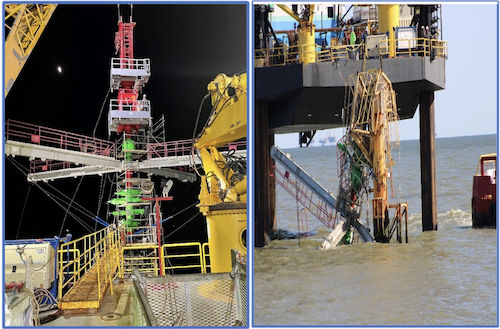
Hydraulic workover unit before, left, and after, right, the fatal incident,.Source: BSEE