
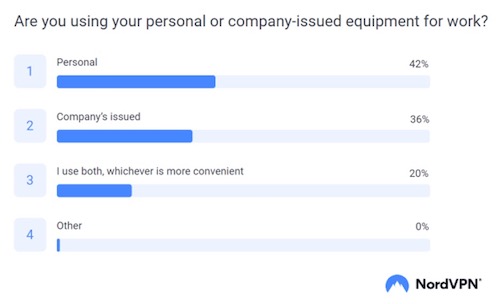
Working from home has created new cybersecurity risks for many people to the point of 62 percent of employees are vulnerable to cyber attacks due to using personal computers for remote work during the COVID-19 pandemic, new research found.
“Personal laptops might lack the necessary security software, such as an antivirus, a business VPN, and others. On top of that, people tend to be more relaxed when using personal computers. They may download games, browse shady websites, and click suspicious links,” said Daniel Markuson, a digital privacy researcher at NordVPN, a VPN service provider, which conducted the research.
Add on top of that, a new report by Kaspersky revealed 51 percent of workers admit to watching adult content on devices they use for work purposes.
Kaspersky’s research revealed additional concerns.

Employees feel unprepared to face cybersecurity issues that may arise when working from home. Almost three-quarters (73 percent) of workers said they had no special IT security awareness training after they switched to working from home full-time. In addition, only half (53 percent) of workers said they are using a VPN to access their employer’s network when working from home.
“VPN gives employees secure access to their work-related documents and information. So, the fact that nearly half of the surveyed people don’t use it raises serious concerns,” Markuson said.
Despite not taking security measures, most respondents are very organized when it comes to working from home. Along those lines, 74 percent have either a dedicated office or a desk for work, 11 percent use the kitchen table, 5 percent work from the sofa, and 3 percent have no set comfortable place and move around. Just 2 percent of respondents work from their beds.
However, according to the Kaspersky research, 32 percent of employees say their current working conditions are less comfortable than their usual office environment. This is probably because they don’t have the proper office chairs and desks. The research also reveals people are suffering from back pain by resorting to using kitchen stools or slouching on their sofas.
When it comes to maintaining a proper work-life balance, people don’t feel like their work-life balance is suffering. Almost half, 48 percent, had no trouble separating their work from their free time, 33 percent had difficulty in balancing work and leisure, and 18 percent were undecided.
But daily server loads of NordVPN Teams, a product only used for work purposes, revealed people are spending up to 3 hours longer logged in. That means the average workday is now approaching 11 hours. This 37.5 percent jump in working hours was chiefly recorded in the U.S., but the numbers have been rising all over the world. For example, the UK, Canada, France, Spain, and other European countries saw a 2-hour increase.
People also seem to be careful when it comes to new apps — 54 percent of all respondents hadn’t downloaded any new apps since the lockdown began. Just 24 percent downloaded new apps deemed necessary by their employer, 12 percent chose apps for leisure (such as exercise, cooking, or gaming apps), and 8 percent got new productivity apps.
In the end, 43 percent of respondents thought they were more productive when working from home, compared to 36 percent who felt ambiguous about the situation. Only 19 percent claimed they were less productive.
This study was conducted over the last two weeks of March when 5,000 people working from home due to social distancing took part in the survey.