
Over the last year, AI gained a foothold in cybercrime and in 2026 it will dominate as attackers use AI agents to compress patch-to-exploit timelines to minutes and scale multi-stage intrusions beyond what human vulnerability researchers can sustain, according to a report by ThreatDown, the corporate business unit of Malwarebytes .
To add to that, as data is an organization’s most valuable commodity, cybercriminals make money from holding that information for ransom or selling it. The average ransom payment in the first half of 2025 was $750,000 while the total cost of a data breach was six times higher at $4.4 million.
The commoditization of ransomware and a growing library of playbooks and turnkey attack methods means that small and medium size enterprises (SMEs) must repel the same threat actors as larger organizations with fewer resources and disproportionately greater consequences.
Furthermore, this past year was the worst year for ransomware on record, with attacks increasing eight percent year-over-year and impacting organizations in 135 countries, the report said.

The research shows attackers moved faster, used legitimate tools and stolen credentials to blend in with normal activity. Attackers are also increasingly staging ransomware from unmanaged systems and network blind spots, undermining traditional security and recovery controls.
Additionally, attackers now prefer to use remote monitoring and management (RMM) tools for persistence rather than malware like remote access Trojans that might trigger detection from an endpoint protection platform (EPP).
“We’re seeing cybercrime evolve from manual, one-off intrusions into operations that move faster, scale further, and cause more disruption,” said Kendra Krause, general manager of ThreatDown. Indeed, “AI is removing many of the natural limits that attackers once faced. When discovery, movement, and extortion can happen in minutes instead of days, businesses have far less time to respond, and the stakes get much higher.”
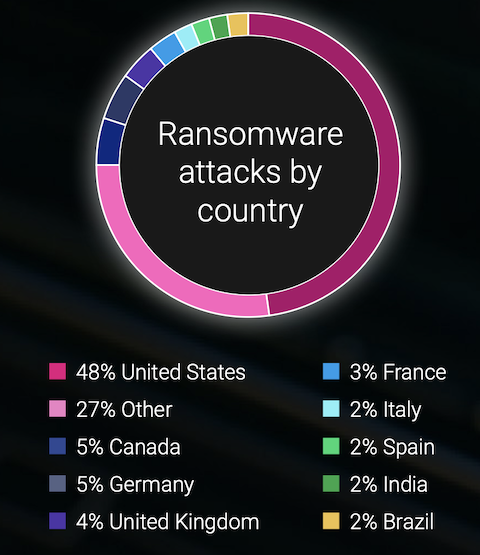
U.S. remained the most attacked country in the world, accounting for almost half of all known ransomware events in 2025.
Source: ThreatDown
Other Top Features
Key findings of the report include:
- AI-driven operations push cybercrime toward machine scale: AI agents can now run multiple simultaneous intrusions autonomously, create exploits from patches in minutes, and outperform elite human researchers in bug bounty programs, accelerating vulnerability discovery and compressing patch-to-exploit timelines.
- Remote encryption becomes a defining ransomware tactic: The most disruptive incidents involved remote encryption attacks, which accounted for 86 percent of ransomware activity in 2025 and allowed adversaries to encrypt data across protected environments without running malware locally.
- Attackers are designing intrusions to be invisible until it’s too late: In 2025, ransomware operators prioritized speed, stealth, and timing over persistence by moving at night or during holidays, using legitimate IT tools, launching attacks from blind spots, and disabling security and backups before encryption begins.
- Ransomware targets wealthier, low-risk jurisdictions: The United States accounted for nearly half of all known ransomware incidents in 2025, with attacks heavily concentrated in other English-speaking economies and Western Europe.
“Defenses today have to assume that intrusions won’t always look like malware, and they won’t arrive with obvious warning signs,” Krause said. “Teams that perform best are the ones that close unmanaged endpoints, protect recovery paths, and have experts watching and responding around the clock, because when attacks move this fast, minutes matter.”
Click here to register for the full report.