
Additionally, ransomware victim numbers hit a new all-time high last year with 2,287 victims posted in the fourth quarter alone, according to the GuidePoint Research and Intelligence Team’s (GRIT) annual Ransomware & Cyber Threat Report. There were 7,515 total attacks discovered last year.
“The GRIT 2026 Ransomware & Cyber Threat Report shows the most active year for ransomware we’ve ever recorded, revealing a 58 percent year-over-year increase in ransomware victims,” said Jason Baker, lead threat analyst at GuidePoint Security. “While law enforcement disruptions have reshaped the Ransomware-as-a-Service (RaaS) ecosystem, group fragmentation is driving new patterns of high-volume, repeatable operations, pushing overall activity to record-breaking levels.
“The rise of Qilin as the most active group we ever tracked – surpassing even LockBit at its peak – underscores how the ecosystem is evolving,” Baker said. “For organizations, well-resourced defenders, proactive vulnerability management and real-time threat intelligence will be critical for mitigating risk in the year ahead.”
Growth Year
What initially started as an average year in terms of growth turned surprising by the end of December, shattering all records and resulting in a 58 percent year-over-year (YoY) increase in the number of observed ransomware victims, claimed by a record-breaking 124 distinct named groups, the researchers said. Data collected for this report came from publicly available resources, including the sites and blogs of threat groups themselves.

Researchers found former mid-tier groups, such as Qilin and Akira, stepped in to fill the spots formerly filled by LockBit and Alphv, likely absorbing affiliates in the process. Still other groups, such as RansomHub, obtained short-term successes only to end up undone by internal deceit and infighting – with the associated affiliates similarly reorganizing under other groups.
“We continued to observe indications of threat actor adoption of Artificial Intelligence (AI) and Large Language Models (LLMs) in their operations, though we have found concerns of super-affiliates deploying fully autonomous ransom-bots to be overstated,” the report said. “AI/LLM usage remains rudimentary among less mature threat actors, though the more sophisticated and experienced operators have prioritized finding new means and manners of incorporating AI. Their successes will almost certainly trickle down over time in the same way that vulnerability exploitation has for years.”
As mentioned manufacturing claimed the most ransomware victim organizations. Moreover, the four most impacted industries in terms of victim volume – manufacturing, technology, retail and wholesale, and healthcare – remained consistent year over year from 2024 to 2025, according to the report.
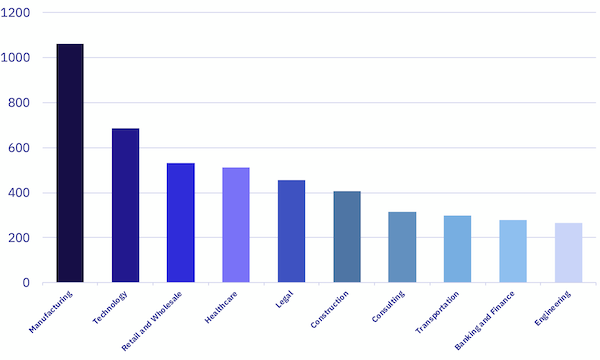
The four industries hit the most were manufacturing, technology, retail and wholesale, and Healthcare.
Source: GRIT Ransomware & Cyber Threat Report
Validating Simulations
While this can potentially be explained, in part, by the prevalence the industries in the U.S. economy, it also may speak to vulnerabilities or threats which uniquely impact organizations in these industries.
Researchers said these industries are more likely to experience financial or operational losses from ransomware’s impacts on networks, and to hold high-value or particularly sensitive data.
Click here to download the full report.