
Having said that, others seem to be taking a cautious approach – for now.
“AI is reshaping how organizations operate, and cybersecurity is no exception,” said ISC2 Chief Qualifications Officer Casey Marks in the organization’s 2025 AI Adoption Pulse Survey that measured the adoption of AI security tools across cybersecurity teams. “Our latest AI Survey shows cautious but growing interest in AI security tools, with adoption expected to accelerate in the future.”
ISC2, a nonprofit member organization for cybersecurity professionals, published its survey based on insights from 436 global cybersecurity professionals at organizations of all sizes. The research assesses the impact of AI adoption on team effectiveness, entry-level jobs and cybersecurity hiring.
“Encouragingly, 44 percent of professionals report no impact on hiring from current or expected adoption of AI security tools, and 28 percent see AI creating new opportunities for entry-level talent,” Marks said. “Findings suggest that AI is helping cybersecurity professionals by automating repetitive tasks and enabling them to focus on more meaningful work.”

AI Potential for Security
AI-based security tools have the potential to enhance cybersecurity capabilities, increase efficiency and reduce human error, while increasing the ability to address the growing scale and sophistication of modern threats.
To date, 30 percent of cybersecurity professionals have already integrated AI security tools into their operations, defined in the survey as “AI-enabled security solutions, generative AI, and/or agentic AI for automatic action,” according to the survey.
A majority of respondents from organizations actively using AI security tools are experiencing this. Of this group, 70 percent are seeing positive results from their AI tools, supporting their team’s overall effectiveness.
Additionally, 42 percent are currently exploring or testing their adoption, indicating strong momentum toward future implementation.
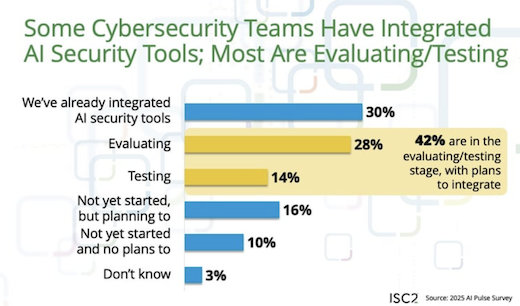
Some security teams have already adopted AI, while 42 percent are currently testing or evaluating the technology.
Source: ISC2, 2025 AI Adoption Pulse Survey
Top five areas where AI security tools will have the most positive impact on operations in the shortest amount of time – improving efficiencies and automating time-consuming tasks:
- Network monitoring and intrusion detection: 60 percent
- Endpoint protection and response: 56 percent
- Vulnerability management: 50 percent
- Threat modeling: 45 percent
- Security testing: 43 percent
In terms of who is adopting AI security tools, the largest organizations, with over 10,000 employees, lead in the adoption rate with 37 percent actively using them. This is closely followed by mid-to-large (2,500–9,999 employees) and smaller (100–499 employees) organizations, each with 33 percent adoption.
In contrast, mid-sized (500–2,499 employees) and the smallest (1–99 employees) organizations show the lowest adoption rates, with only 20 percent in each group actively using AI for security. Notably, the smallest organizations are also the most conservative, with 23 percent reporting no plans to evaluate AI security tools.
Industrial Sector Tops Adoption
Among industries adopting, evaluating or testing AI tools for their security operations, industrial enterprises (38 percent), IT services (36 percent), commercial/consumer sectors (36 percent), and professional services organizations (34 percent) are leading the way. Financial services and the public sector currently report the lowest adoption rates, at 21 percent and 16 percent, respectively.
When it comes to jobs and AI, a majority of respondents agree AI security tools will affect hiring at the entry level in cybersecurity.
More than half (52 percent) said AI will significantly or somewhat reduce the need for entry-level staff. However, 31 percent expressed a more optimistic view, believing AI will also create new types of entry- and junior-level roles or increase demand, helping to counter the decline elsewhere in early-career opportunities.
Respondents expressed optimism about the wider cybersecurity hiring landscape amid AI adoption.
To that end, 44 percent agreed their organization’s cybersecurity hiring has not yet been affected by the introduction of AI security tools. On the other end, 21 percent said AI has changed their hiring plans and priorities in their organizations.
As AI continues to evolve, organizations must strike a balance; embracing its efficiencies while prioritizing investment in entry-level opportunities to ensure the cybersecurity workforce remains agile, skilled and future-ready.
Click here for more on the full report.