
In December last year, the vulnerability (CVE-2021-44228) of Java-based logging utility Log4j became a worldwide issue, said researchers at Ahnlab’s Security Emergency response Center (ASEC). It is a remote code execution vulnerability that can include the remote Java object address in the log message and send it to the server using Log4j to run the Java object in the server.
The ASEC analysis team was monitoring the Lazarus group’s attacks on targets in Korea. In April, the team discovered an attack group suspected of being Lazarus distributing NukeSped by exploiting the vulnerability.
To that end the attacker used the Log4j vulnerability on VMware Horizon products that were not applied with the security patch, the researchers aid. The products are virtual desktop solutions, used mainly by companies for remote working solutions and cloud infrastructure operations. With the recent spread of Covid-19, it is likely that many companies are using the products for remote working.
NukeSped is a backdoor malware that can receive attacker commands from the C&C server and perform the received commands. The malware type ASEC researchers found is one of the variants of NukeSped, that have been used by the Lazarus group since 2020.

The variant is developed with C++. As it uses virtual functions, class names are included in the binary, the researchers said.
It normally uses DES algorithm to decrypt internal strings including API names and the list of C&C servers, the researchers said. To communicate with the C&C server, it uses the RC4 algorithm. But there are some changes as well: For this attack, there was a type using the RC4 algorithm for internal strings, a list of C&C servers, and C&C server communication. Each process uses a different value for the RC4 key.
After the process for decrypting strings and API Resolving is complete, the malware starts communicating with the C&C server, the researchers said. NukeSped goes through an additional verification process after accessing the C&C server by sending a string disguised as SSL communication. When the malware receives certain strings, it will recognize the server as a normal C&C server and proceeds with the routine.
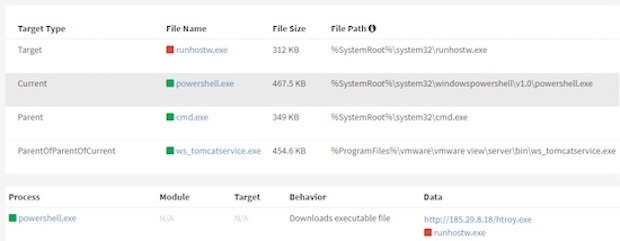
AhnLab Smart Defense log for NukeSped installation.
Source: ASEC
The malware then finds the MAC address of the user environment and sends it to the C&C server after encrypting it with the RC4 algorithm. It will also encrypt packets with the algorithm in the subsequent communications.
NukeSped can perform keylogging, taking screenshots, and file and shell tasks depending on the command it receives.
Click here for more details.