
Now, a “bio-nose” project aims to create a portable, biologically based device capable of identifying odors in the built environment, backed by a four-year, $2 million grant from the National Science Foundation.
“If we had handheld devices that could recognize complex odors, a lot of things would be possible,” said project leader Elisabeth Smela, a University of Maryland professor of mechanical engineering. “There are applications in food, wine, perfumes, medical diagnostics, homeland security, agriculture, mold detection, and more.”
However, in the past, using cells for this type of application has been challenging. Mammalian cells need feeding and remain at body temperature to stay alive, necessitating a more practical approach.

Dry Cells
“Think about the yeast that you keep dried at home. Wouldn’t it be nice if we had some cells that we could keep dry until we were ready to use them?” Smela asked.
The team’s collaborators at the National Agriculture and Food Research Organization (NARO) in Japan created an insect-based cell line capable of just that.
The cells can end up desiccated, or dried, and then re-animated with the addition of fluid at room temperature. Such cells don’t normally express olfactory receptors, so the NARO researchers added the genes into the cell line to allow them to sense odors.
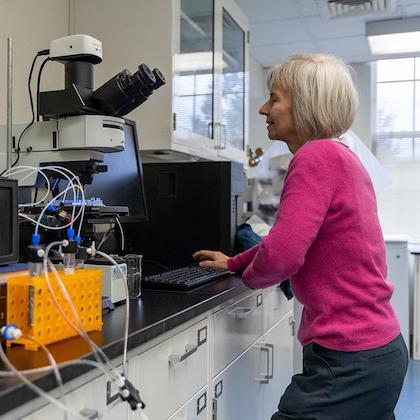
Professor Elisabeth Smela at work on her bio-nose project in the lab.
Source: Joanna Avery/Maryland Engineering
Currently, the team is studying how the cell line responds when it is introduced to different liquids – one step of many on the way to developing a fully usable bio-nose device. Future challenges include detection of airborne odorants and using machine learning to discover how a collection of cells reacts when exposed to various odors in order to identify the sources.
“The addition of biological components to technology as well as the positive impact that an artificial nose could have on people’s lives makes this research particularly exciting,” Smela said.