
In the real world, fuel fires must end up extinguished with special kinds of chemicals, and the ones most commonly used are aqueous film-forming foams (AFFFs).
However, environmental and health concerns about AFFFs launched widespread efforts to detect, monitor and eventually eliminate them. Now, researchers at the National Institute of Standards and Technology (NIST) released new reference materials to expedite these efforts.
What makes the foams so effective are chemical compounds called per- and polyfluoroalkyl substances (PFAS), enabling them to suppress fuel fires much more quickly and efficiently compared with other alternatives.

Due to their significant ability to resist heat and chemical changes, the PFAS in these foams break down slowly over time, giving them the name “forever chemicals.” The foams can easily leak into nearby water and soil and affect the surrounding ecology, raising concerns because experts linked PFAS to negative health effects such as certain cancers.
Because of these concerns, organizations including the Department of Defense (DoD) are starting to eliminate the use of PFAS-containing materials. Under the 2020 National Defense Authorization Act, the DoD must stop purchasing AFFFs from manufacturers by October 2023 and will stop using them by October 2024.
To help with this phaseout, NIST researchers collaborated with the DoD on a series of AFFF reference materials (RMs) containing PFAS. During the phaseout process, older AFFFs will still be around, but the RMs will help organizations identify foams with PFAS so they can remove them from use.
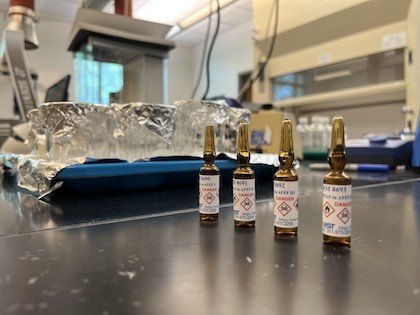
A series of reference materials contain precise measurements of per- and polyfluoroalkyl substances (PFAS), called “forever chemicals,” in firefighting foams. These foams, called aqueous film-forming foams (AFFFs), end up used to suppress fuel fires. Analytical labs can use the reference materials for measuring PFAS in the foams so they can remove them.
Source: NIST
While manufacturers aim to meet the new military specifications for their foams to contain less than 1 parts per million (ppm) PFAS, “There are still legacy AFFFs sitting across the country, and they will need to have measurements made to show if they contain PFAS,” said NIST chemist Jessica Reiner. She added if they find PFAS, then they will need to dispose of them properly.
NIST released four RMs containing different formulations of PFAS in the foams.
“These four RMs contain many of the different PFAS used in the legacy AFFFs (they are phasing) out. The RMs are useful for labs that want to test for these,” Reiner said.
The RMs will also help the military when purchasing alternative fire suppressants.
“Because the military has to stop purchasing these foams, they need to test for PFAS in the new foams that they buy. By having these RMs, they can measure for PFAS. Manufacturers producing new foams could also use the RM when they need to test if they are PFAS free,” Reiner said.
NIST researchers sent the RMs to a number of other labs for testing in what’s called an interlaboratory study. They learned scientists had a hard time measuring PFAS in foam form. NIST researchers then designed the new reference materials in a specific way so each individual formulation ends up diluted to make it easier to use.
Analytical labs, academic institutions, and the U.S. Department of Transportation are a few other examples of groups that can use the RMs. “For example, anyone in a toxicology group could use these RMs for scientific experiments, such as delivering doses of the compounds to study their effects on cells,” Reiner said.