
That, however, may soon come to a halt as Osaka Metropolitan University chemists are looking to end to the “forever” life of PFAS with their simple yet innovative technique that converts these harmful substances into valuable compounds. The per-and polyfluoroalkyl substances (PFAS) are a group of chemicals used to make fluoropolymer coatings and products that resist heat, oil, stains, grease, and water.
A research group led by Professor Masato Ohashi and Assistant Professor Kenichi Michigami of the Graduate School of Science at Osaka Metropolitan University successfully synthesized ligands called fluorine-decorated N-heterocyclic carbenes (NHCs) from perfluoroalkenes, a type of PFAS (Perfluoroalkyl and Polyfluoroalkyl Substances).
The synthesis of fluorinated NHCs came about simply enough by removing two fluorine atoms from 1,2-difluoroalkene derivatives.

Owing to the small size of fluorine atoms, the electron-accepting ability of the NHC ligand can end up enhanced without substantially changing its steric properties.
“Our results enable the easy transformation of harmful PFAS into functional NHCs,” Michigami said. “The versatile applications of fluorinated NHCs show potential advantages in various fields such as fluorine chemistry, organometallic chemistry, catalysis chemistry, and materials science.”
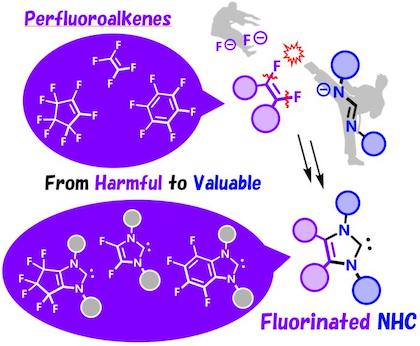
The conversion of PFAS to a functional compound ended up achieved by simply removing two fluorine atoms from 1,2-difluoroalkene derivatives
Source: Kenichi Michigami, Osaka Metropolitan University