
To back that up, 96 percent of manufacturers have already or plan to invest in cybersecurity platforms within the next five years, and more than half are already adopting cybersecurity at-scale, according to Rockwell Automation’s 10th Annual State of Smart Manufacturing Report.
The report draws from responses from 1,560 decision-makers across 17 manufacturing nations, representing companies that range from $100-million operations to multi-billion dollar enterprises. In the end, cybersecurity ranks right alongside safety, throughput and cost as a core performance metric.
“Cybersecurity is no longer just a technology issue – it’s a boardroom issue,” said Stephen Ford, vice president and chief information security officer at Rockwell Automation. “As IT and OT become more connected, the attack surface is expanding. Our latest research confirms what we’re seeing firsthand: Cyber risk is now one of the top threats to manufacturing growth. You can’t protect tomorrow’s enterprise with yesterday’s tools. AI is a critical part of the modern security stack, enabling manufacturers to detect threats in real time, maintain productivity, and stay ahead in an increasingly aggressive threat landscape.”

6 OT Forces
To that end, the survey reveals six forces pushing OT security to the forefront: Universal platform adoption; budget synergies with automation; board level risk scrutiny; secure by design hardware; a cyber literate workforce, and a culture where safety and security work together.
Universal platform adoption:
Nearly every manufacturer is adopting an OT security platform. To date, according to the survey, 64 percent already run one, and 32 plan plan to deploy one within the next five years.
With implementation now a forgone conclusion, the discussion always goes back to cost benefit analysis. Company leaders now ask vendors things like how many audit hours can end up saved, how quickly can we deploy patches and how can we decrease unplanned downtime.
Source: Rockwell Automation’s 10th Annual State of Smart Manufacturing Report
Overall equipment effectiveness or mean time to recovery hold the upper hand, according to the report.
Budget synergies with automation:
53 percent of manufacturers list securing OT assets as a primary spark for technology investment, according to the report.
More than half of respondents are already adopting security at-scale. This digital transformation shift recasts security leaders as growth enablers. Position hardened networks as the foundation for predictive maintenance, real time energy management or AI assisted quality checks, and risk reduction suddenly comes with revenue upside.
Board level risk scrutiny:
30 percent of respondents rank cyber risk among their most serious external obstacles.
Executives and the insurers that underwrite their risk now expect precise metrics: Projected financial loss if a cyber incident hits, how often response drills are run and what they uncover, and a clear, scored view of control maturity across the OT environment.
It falls to security leaders to translate technical vulnerabilities into business terms like lost revenue, potential downtime and brand impact, so executives can weigh cybersecurity spending against other capital priorities.
Secure by design hardware:
31 percent of respondents aim to curb OT risk with embedded security controls, according to the report.
Controller-level access rules, signed firmware and onboard telemetry are becoming standard features. These deeper defenses, however, demand disciplined firmware-lifecycle management and procurement language that prioritizes security alongside performance specifications.
Cyber literate workforce:
81 percent of respondents place high or top-tier priority on knowledge around cyber practices and standards, according to the report. Nearly half of manufacturers (47 percent) rank these skills as “extremely important” when hiring over the next 12 months, with another 34 percent calling them “very important.”
Manufacturers are embedding micro-training into shift handovers, funding certifications and tying security performance (e.g., patch compliance) to individual reviews. Over time, secure behavior becomes as routine as lockout/tagout procedures.
Culture where safety and security work together:
Employee culture and leadership awareness emerge as equal pain points to adoption: 25 percent of manufacturers say employee resistance to change blocks smart manufacturing rollouts, and another 25 percent flag limited cybersecurity awareness among senior decision-makers as a top leadership obstacle over the next 12 months, according to the report.
Mindset, not knowledge, often slows progress. Operators may see additional controls as production bottlenecks, while managers prioritize short-term output. Embedding cybersecurity in the broader safety culture, supported by recognition programs and cross-functional drills, ensures a stronger behavior toward security.
Other key global cybersecurity findings from the report include:
- Cyber threats are among the most serious external risks. Cybersecurity (30 percent) now ranks among the top external risks, a close second to inflation and economic growth (34 percent).
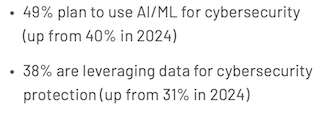
- Security teams accelerate AI adoption. 61 percent of cybersecurity and IT professionals plan AI and machine learning (ML) adoption for security in the next 12 months, outpacing general manufacturing by 12 percentage points.
- Cybersecurity tops smart manufacturing use cases. 38 percent of manufacturers plan to use data collected from current sources to drive protection.
- IT/OT security takes center stage. 48 percent of cybersecurity professionals identified securing converging architecture as a key to positive outcomes over the next five years, compared to just 37 percent on average.
- Cyber readiness is a growing talent priority. 53 percent of respondents from companies of $30 billion or more identified cybersecurity practices and standards as extremely important skill sets, compared to 47 percent of all respondents.
OT cybersecurity can no longer be something that would be nice to have and something to think about, it needs to be a mandate. An investment into a cybersecure platform will reduce risk and lead to continued uptime and more profitability.
Click here to download the report.