
In 40 percent of attacks, threat actors threatened to harm executives at organizations that declined to pay a ransom demand, according to cybersecurity provider, Semperis’ 2025 Ransomware Risk Report: Essential Guidance for Building Operational Resilience Against Cyberattacks. To that end, U.S.-based companies experienced physical threats 46 percent of the time, while 44 percent of German firms experienced similar risks.
Semperis’ report studied nearly 1,500 organizations in a variety of industries with the goal of understanding their experience with ransomware over the last 12 months.
Manufacturing/Utilities Sectors
In the manufacturing/utilities sectors, 81 percent of organizations ended up targeted by ransomware in the past year, with 50 percent of attacks succeeding. Additionally, 63 percent ended up paying the ransom.

On top of that, 21 percent of respondents said it took less than one day to return to normal operations, while 63 percent said it took between one day to one week and 16 percent said it took one week to one month.
In comparing results from last year’s ransomware study, Semperis found slight decreases year over year in companies paying ransoms. Still, 69 percent of companies across all industries victimized by ransomware paid a ransom.
Furthermore, 38 percent of companies paid multiple ransoms and 11 percent of companies paid three times or more. In the U.S., 47% of companies paid ransoms multiple times, while in Singapore 50% of companies paid multiple times.
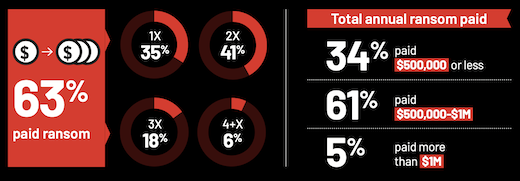
For manufacturing and utilities, the amount of organizations that paid ransomware and how much they paid.
Source: Semperis
“Now is not the time for complacency,” said former U.S. National Cyber Director and Semperis Strategic Advisor, Chris Inglis. “True regret isn’t knowing what you should have done; it’s not having done what you knew was needed and had the means to do.”
Ransomware attacks continue to end up highly coordinated, strategically timed and deeply embedded throughout systems before execution. This gives multiple attackers access to multiple operational systems – so they can execute numerous strikes. That means organizations need to remain on continual alert, always ready for the success of not one, but multiple breaches.
The findings indicate ransomware attacks are frequent, with 50 percent of respondents citing cybersecurity threats as the top threat to business resilience.
Sophisticated Attacks
The top cybersecurity challenge facing organizations is the sophistication of attacks (37 percent), while next (32 percent) is attacks against organizations’ identity infrastructure, most commonly Active Directory.
Additionally, nearly 20 percent of companies that paid a ransom either received corrupt decryption keys that were unusable or the hackers still published stolen data after stating they would not.
“Paying ransoms should never be the default option,” said Mickey Bresman, chief executive at Semperis. “While some circumstances might leave the company in a non-choice situation, we should acknowledge that it’s a downpayment on the next attack. Every dollar handed to ransomware gangs fuels their criminal economy, incentivizing them to strike again. The only real way to break the ransomware scourge is to invest in resilience, creating an option to not pay ransom.”
To that end, organizations should evaluate the security of partners and supply chain vendors as they could be the weakest link. When partners and vendors have access to sensitive systems and data, risk increases. Organizations should also be prepared for changing tactics in ransomware development and deployment and plan regular tabletop exercises to improve ransomware response.
Click here to the full ransomware study.