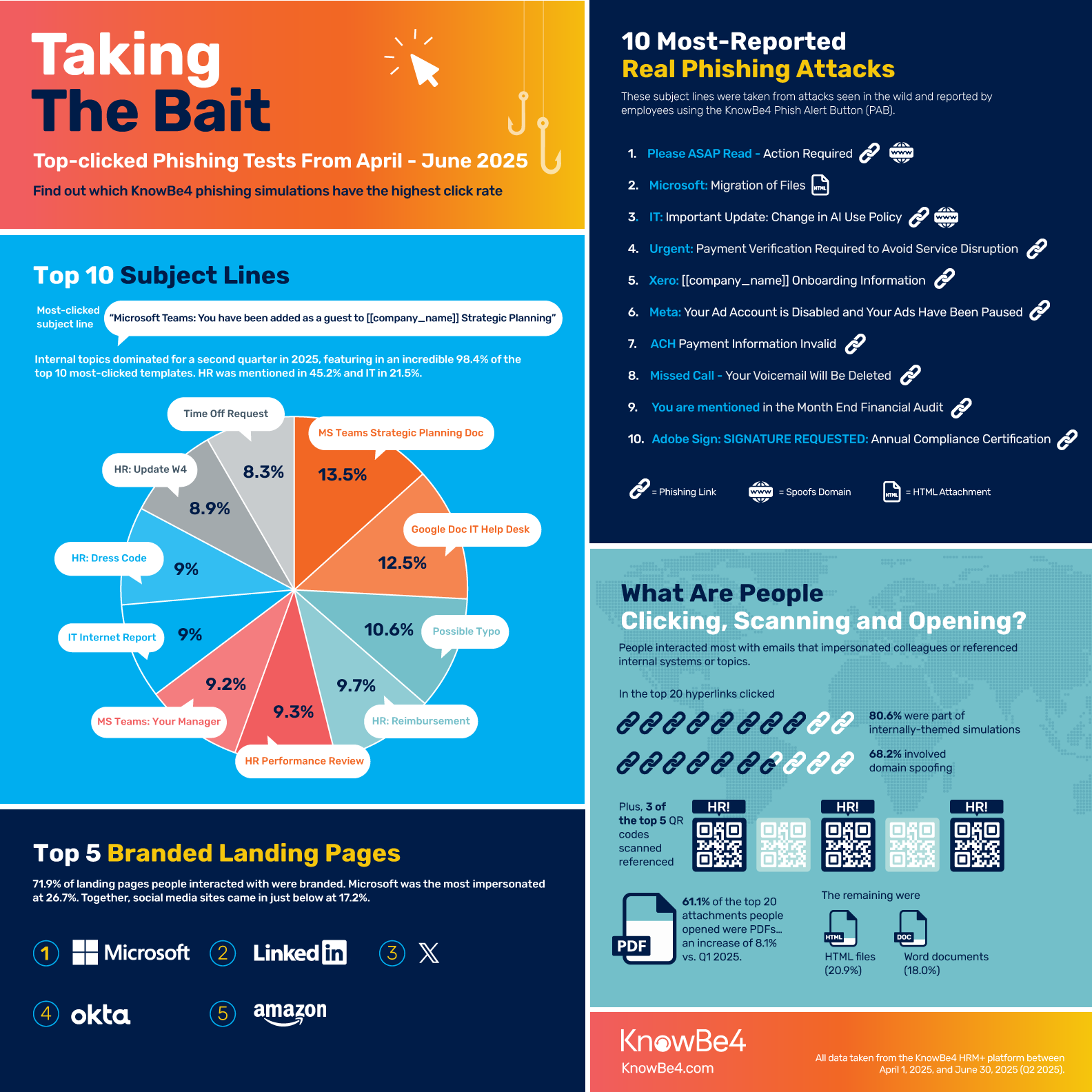
Employees continue to fall for social engineering techniques that exploit familiarity and trust, as seen in dominant interactions with internal communications and well-known brands, a new report found.
To that end, phishing simulation trends remained largely consistent with Q1 where employees’ continue to remain vulnerable to malicious emails that appear familiar, whether from human resources, IT, or major brands, according to the KnowBe4 Q2 2025 Simulated Phishing Roundup report.
All data for this roundup ended up taken from the KnowBe4 HRM+ platform between April 1 and June 30.
<p>“One of the key takeaways from the Q2 Simulated Phishing Roundup is the critical role trust plays in cybersecurity,” said Erich Kron, cybersecurity advocate at security provider, KnowBe4. “Whether that is trust in internal communications, familiar brands, or even known individuals, phishing emails that appear to originate from reputable sources will always have a higher chance of lowering a recipient’s suspicions. We see this time and time again in real-word scenarios, where attackers use sophisticated social engineering tactics to take advantage of this fundamental human instinct, making it harder for employees to distinguish legitimate and malicious emails.”

In the report, researchers found:
- Internal-themed topics made up 98.4 percent of the top 10 most-clicked email templates. Among these, human resources was in 42.5 percent of phishing failures and IT in 21.5 percent.
- 71.9 percent of malicious landing page interactions involved branded content. Microsoft was the most common, accounting for 26.7 percent, followed by LinkedIn, X, Okta, and Amazon.
- 80.6 percent of the top 20 clicked links came from internally-themed simulations. 68.2 percent of these used domain spoofing techniques.
- PDF attachment clicks rose by 8.1 percent compared to Q1. PDFs comprised 61.1 percent of the top 20 attachments, followed by HTML files (20.9 percent) and Word documents (18 percent).
<p>“The Q2 findings reinforce the need for organizations to strengthen their human defenses through a layered approach centered on human risk management,” Kron said. “This includes employee empowerment through a combination of relevant, timely and adaptive security training and intelligent detection technology that can identify and mitigate threats in real time.”
Click here to view the Q2 2025 KnowBe4 Simulated Phishing Roundup infographic.