
This joint Cybersecurity Advisory (CSA), released by the Federal Bureau of Investigation (FBI), Cybersecurity and Infrastructure Security Agency (CISA), and Department of Health and Human Services (HHS), is part of an ongoing #StopRansomware effort to publish advisories for network defenders that detail various ransomware variants and ransomware threat actors.
The advisory provides tactics, techniques and procedures (TTPs) and indicators of compromise (IoCs) of “Daixin Team” actors obtained from FBI threat response activities and third-party reporting.
According to an IC3 annual report in 2021, 649 ransomware reports were made across 14 critical infrastructure sectors; the HPH Sector accounted for the most reports at 148.

The Daixin Team is a ransomware and data extortion group that targets the healthcare sector with ransomware and data extortion operations since at least June 2022. Since then, Daixin Team cybercrime actors have caused ransomware incidents at multiple healthcare sector organizations where they have:
- Deployed ransomware to encrypt servers responsible for healthcare services, including electronic health records services, diagnostics services, imaging services, and intranet services, and/or
- Exfiltrated personal identifiable information (PII) and patient health information and threatened to release the information if a ransom is not paid.
Daixin actors gain initial access to victims through virtual private network (VPN) servers.
In one confirmed compromise, attackers likely exploited an unpatched vulnerability in the organization’s VPN server. In another confirmed compromise, the actors used previously compromised credentials to access a legacy VPN server that did not have multifactor authentication (MFA) enabled. The actors are believed to have acquired the VPN credentials through the use of a phishing email with a malicious attachment.
After obtaining access to the victim’s VPN server, Daixin actors move laterally via Secure Shell (SSH) and Remote Desktop Protocol (RDP). Daixin actors have sought to gain privileged account access through credential dumping and pass the hash. The actors have leveraged privileged accounts to gain access to VMware vCenter Server and reset account passwords for ESXi servers in the environment. The actors have then used SSH to connect to accessible ESXi servers and deploy ransomware on those servers.
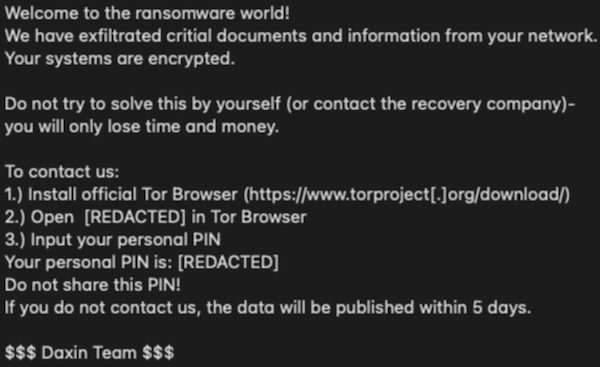
Example of a Daixin Team ransomware note.
Source: Joint CSA
According to third-party reporting, the Daixin Team’s ransomware is based on leaked Babuk Locker source code.
This third-party reporting as well as FBI analysis show the ransomware targets ESXi servers and encrypts files located in /vmfs/volumes/ with the following extensions: .vmdk, .vmem, .vswp, .vmsd, .vmx, and .vmsn. A ransom note is also written to /vmfs/volumes/.
Organizations can implement the following to protect against Daixin and related malicious activity:
- Install updates for operating systems, software, and firmware as soon as they are released.
- Require phishing-resistant MFA for as many services as possible – particularly for webmail, VPNs, accounts that access critical systems, and privileged accounts that manage backups.
- If you use Remote Desktop Protocol (RDP), secure and monitor it.
- Turn off SSH and other network device management interfaces such as Telnet, Winbox, and HTTP for wide area networks (WANs) and secure with strong passwords and encryption when enabled.
- Implement and enforce multi-layer network segmentation with the most critical communications and data resting on the most secure and reliable layer.
- Limit access to data by deploying public key infrastructure and digital certificates to authenticate connections with the network, Internet of Things (IoT) medical devices, and the electronic health record system, as well as to ensure data packages are not manipulated while in transit from man-in-the-middle attacks.
- Use standard user accounts on internal systems instead of administrative accounts, which allow for overarching administrative system privileges and do not ensure least privilege.
- Secure PII/PHI at collection points and encrypt the data at rest and in transit by using technologies such as Transport Layer Security (TPS).
- Protect stored data by masking the permanent account number (PAN) when it is displayed and rendering it unreadable when it is stored – through cryptography, for example.
- Secure the collection, storage, and processing practices for PII and PHI, per regulations such as the Health Insurance Portability and Accountability Act of 1996 (HIPAA).
- Use monitoring tools to observe whether IoT devices are behaving erratically due to a compromise.
- Create and regularly review internal policies that regulate the collection, storage, access, and monitoring of PII/PHI.
- In addition, the FBI, CISA, and HHS urge all organizations, including HPH Sector organizations, to apply the following recommendations to prepare for, mitigate/prevent, and respond to ransomware incidents.
Click here for more on the Daixin Team advisory.