
With high penetration level of wind power resources, the practical dynamic security region (PDSR) with hyper plane expression has outstanding advantages in situational awareness and series of optimization problems.
But to obtain accurate PDSR boundary, you have to locate sufficient critical points around the boundary. To that end, a research team led by Yanli Liu from Tianjin University in China, developed a space division and Wasserstein generative adversarial network with gradient penalty (WGAN-GP) based fast generation method of PDSR boundary.
Traditional methods for transient stability analysis, such as the point-by-point approach, have been time-consuming and often fall short in terms of accuracy and efficiency, especially with the growing complexity of modern power systems.

That is why the research team’s solution addresses these challenges head-on.
Leveraging Space Division
By leveraging space division to narrow the search for critical points and employing the WGAN-GP model for data augmentation, the method significantly compresses the search space and accelerates the generation of critical points. This not only improves the confidence level of boundary fitting results but also enables a precise and efficient assessment of power system transient stability.
First, the researchers established the theoretical foundation for the method, highlighting the differential topological characteristics of the dynamic security region (DSR).
They then introduced the space division technique, which divides the injection space into three areas to focus the search for critical points within the critical operating area where the location of the PDSR boundary is. The WGAN-GP model subsequently ends up used to generate a large number of critical points based on the data distribution learned from a small training set, allowing for the rapid fitting of the PDSR boundary using the least square method.
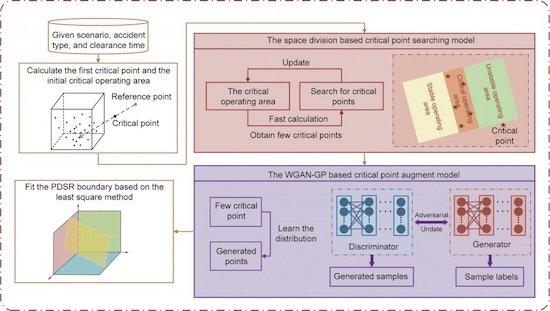
Framework of the proposed rapid generation of dynamic security region boundaries method.
Source: Credit: Yanli Liu
The proposed method ended up tested on the IEEE 39-bus system, with results demonstrating its remarkable accuracy and efficiency. The case study involved replacing traditional generators with wind turbines to simulate real-world scenarios, further validating the method’s practical applicability.
This breakthrough has profound implications for the power industry, offering a powerful tool for schedulers and engineers to maintain system stability amidst the growing integration of renewable energy sources. The method’s efficiency and accuracy could significantly reduce the risk of power system blackouts, ensuring a more reliable and secure power supply.
Refining Method
Looking ahead, the research team at Tianjin University is looking to further refine the method and exploring its application to a broader range of faults.
With the potential to integrate with deep learning technologies, the method could pave the way for even more sophisticated and responsive power system stability solutions.
Click here to view the paper entitled “Space Division and WGAN-GP Based Fast Generation Method of Practical Dynamic Security Region Boundary.”