
The exponential growth of the IoT has brought significant hardware security issues.
Constrained by cost, IoT devices often lack robust encryption mechanisms, making private data vulnerable to attacks. PUFs, which can serve as the root of trust for IoT devices, have emerged as a promising lightweight cryptographic solution. However, conventional CMOS-based PUFs have drawbacks such as insufficient randomness, high power and area consumption, and vulnerability to environmental factors.
It achieves a strong, highly reliable, and reconfigurable PUF that can resist machine-learning attacks. The PUF initializes by setting a specific writing voltage to balance the probabilities of high- and low-resistance states in the memory array to around 50 percent. Then, a computing-in-memory (CIM) approach can generate responses.

1-Bit Response
By comparing the current summations according to different column combinations, a 1-bit response ends up generated, the researchers said.
The performance of the SOT-MRAM sr-PUF has a challenge-response pair (CRP) capacity of109. Its uniformity is 50.07 percent, diffuseness is 50 percent, uniqueness is 49.89 percent, and the bit error rate is 0 percent, even in a 375 K environment. These values are near-ideal, indicating excellent randomness and reliability, the researchers said.
Moreover, the reconfigurability of the PUF is a key feature.
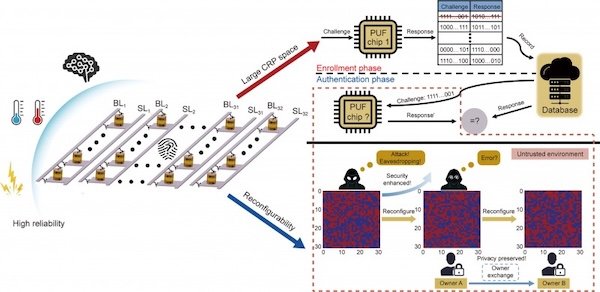
Characteristics summary of 1 kb SOT-MRAM sr-PUF. (Upper right) Large CRP space makes it possible to implement an authentication function; (lower right) reconfigurability enhances security and preserves the privacy of the previous owner when tokens exchange; (left) proposed PUF demonstrates high reliability across different environments and resists ML attacks. BL: bit line; SL: source line.Source: Xiuye Zhang
By applying different write voltages, the PUF can dynamically refresh its CRPs. The reconfigurable Hamming distance is 49.31 percent, and the correlation coefficient between different reconfiguration cycles is less than 0.2. This makes it difficult for attackers to extract output keys through side-channel analysis.
When it comes to machine-learning attacks, the SOT-MRAM sr-PUF shows great resilience. Tested with three machine-learning algorithms (logistic regression, support vector machine, and multilayer perceptron), its prediction accuracy is close to the ideal 50 percent, meaning it can effectively resist those attacks.
This research represents a step forward in the field of PUFs.
More Details
The SOT-MRAM-based PUF offers a practical and reliable hardware security solution for future IoT applications, potentially enhancing the security of countless IoT devices.
There is a paper on the subject, entitled “Experimental Realization of Physical Unclonable Function Chip Utilizing Spintronic Memories.” Xiuye Zhang, Chuanpeng Jiang, Jialiang Yin, Daoqian Zhu, Shiqi Wang, Sai Li, Zhongxiang Zhang, Ao Du, Wenlong Cai, Hongxi Liu, Kewen Shi, Kaihua Cao, Zhaohao Wang, Weisheng Zhao worked on the paper.