
One component of that consortium is the Center for Assured and Resilient Navigation in Advanced TransportatION Systems (CARNATIONS) at Illinois Institute of Technology (Illinois Tech) which is now a Department of Transportation Tier 1 University Transportation Center (UTC) and just received a $10 million grant.
A major aircraft manufacturer reported more than 10,000 global navigation satellite system (GNSS) interference events in 2021 alone, and repeated spoofing had an impact on a range of military operations internationally.
With a broad coalition of university collaborators and industry advisers, Professor of Mechanical and Aerospace Engineering Boris Pervan and his team plan to approach the problem from several angles, including developing sophisticated algorithms that can tell the difference between authentic or spoofed GPS signals and improving GPS receivers by combining them with other types of sensors that are immune to jamming and spoofing.

Addressing these problems is essential to intelligent transportation systems that rely on GPS not just for navigation but for control, such as in self-driving cars, which Pervan has experience researching.
CARNATIONS will be looking to the possibility of a fully connected system, where self-driving cars share information with each other and with smart infrastructure such as traffic signals.
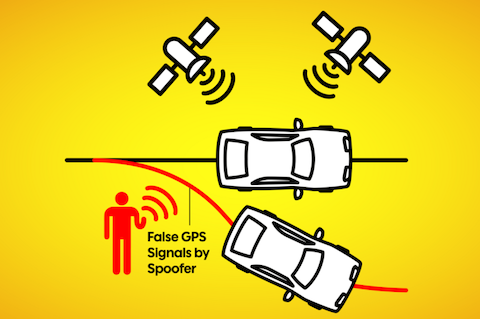
An autonomous vehicle guided by satellite navigation requires secure systems to avoid cyberattacks.
Source: Illinois Institute of Technology
“Spoofing vehicles can be very dangerous,” Pervan said. “If you spoof one car and that information passes on to others, it’s infecting the whole system. On the other hand, the information from the other vehicles could be of some use to tell you that you’re being spoofed, so right now we have no idea how that trade-off will play out.”
CARNATIONS will create workforce development programs, develop certificates, and prioritize educating the next group of transportation professionals.
In addition to Pervan, Illinois Tech Professor of Mechanical and Aerospace Engineering Matthew Spenko and Research Associate Professor Samer Khanafseh will conduct research through CARNATIONS. Chicago State University, Stanford University, University of California Riverside, and Virginia Polytechnic Institute and State University are also CARNATIONS consortium members.
“Our nation’s infrastructure increasingly relies on connected and automated technologies, with significant potential cybersecurity risks,” said U.S. Senator Dick Durbin (D-Illinois). “Illinois Institute of Technology will help develop innovative solutions to protect our nation’s transportation infrastructure from cybersecurity risks. This partnership with Chicago State University will train the next generation of engineers on innovative technology to identify, mitigate, and remove cybersecurity risks from our transportation infrastructure.”