
That just goes to show attacks on sensitive data in files are frequent and costly and indicate a need for manufacturers to understand the risk and then make an investment in an effort to reduce the threat.
To that end, an new report is out showing 61 percent of respondents said their organizations have had an average of eight data breaches or security incidents due to unauthorized access to sensitive and confidential data in files in the past two years, according to research data from Ponemon Institute on behalf of OT cybersecurity provider, OPSWAT.
In the report, Ponemon surveyed 612 IT and IT security practitioners in the United States who are knowledgeable about their organizations’ approach to file security, which refers to the methods and techniques used to protect files and data from unauthorized access, theft, modification or deletion.

Incident Costs
While the average cost of incidents for organizations in the past two years was $2.7 million, 66 percent of respondents said the average cost of all incidents in the past two years was between $500,000 and more than $10 million.
The reality is no matter how you look at it, the bottom line of organizations ends up impacted by the loss of customer data and diminished employee and workplace productivity, which are the most common consequences from these security incidents.
In terms of file security incidents, insiders pose the greatest threat.
The most serious risk ends up at the hands of malicious and negligent insiders who leak data (45 percent of respondents). Other top risks are file access visibility and control (39 percent) and vendors providing malicious files and/or applications (33 percent). Moreover, 40 percent of respondents said their organizations can detect and respond to file-based threats within a day (25 percent) or within a week (15 percent).
Another risk may seem obvious, but files are most vulnerable when they end up shared, uploaded and transferred.
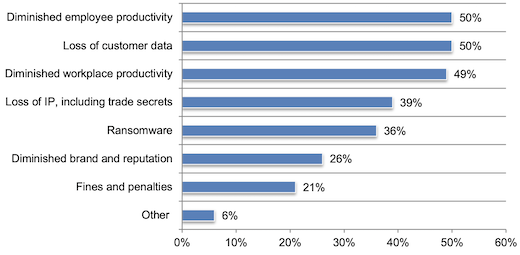
The consequences of a data breach or security incident due to unauthorized access to sensitive and confidential data in the past two years.
Source: Ponemon/OPSWAT
To that end, 39 percent of respondents remain confident files are secure when transferring to and from third parties and 42 percent of respondents are confident files are secure during the file upload stage.
In terms of securing file uploads, the Open Web Application Security Project (OWASP) released principles on how to go about securing them. According to 40 percent of respondents, the principle they will most often use or will use is to store files on a different server. Thirty-one percent said they only allow authorized users to upload files.
On-Premise Storage Risky
Along those lines, the file-based environment that poses the most risk is file storage such as on-premises, NAS and SharePoint, according to 42 percent of respondents. Additionally, 40 percent of respondents said web file uploads such as public portals and web forms are a security risk.
Macro-based malware and Zero Day or unknown malware are the types of malicious content of greatest concern to file security. Organizations encountered these types of malicious content and remain most concerned about macro-based malware and Zero Day or unknown malware according to 44 percent and 43 percent of respondents, respectively.
The effectiveness of file management practices primarily ends up measured by how productive IT security employees are, according to 52 percent of respondents. Other metrics include the assessment of the security of sensitive and confidential data in files (49 percent) and fines due to missed compliance (46 percent). Just over half (51 percent) said their organizations are very or highly effective in complying with various industry and government regulations that require the protection of sensitive and confidential information.
Click here to register to download the report.