
As a part of an attack, threat actors will place phony QR (quick response) codes that direct smartphone users to enter their sensitive private information in fake websites masquerading as bank websites, parking enforcement offices, or other official-looking sources.
That type of attack could soon meet its match as a new form of QR codes – called self-authenticating dual-modulated QR (SDMQR) – could protect smartphone users by signaling if users are going to a safe link or a potential scam, said researchers at the University of Rochester in a new study.
When a code ends up scanned by a user, the QR code decoder can signal to the user whether the link is from a verified source and it is safe to follow, or if it is from an unverified source for which users should exert caution in following the link and in sharing sensitive personal information.

Easy Retrofit
Importantly, the added layer of security with SDMQR codes comes transparently, without any interference with the existing functionality of a QR code.
“Retrofitting security is always a key challenge because once you’ve got existing players in the game, and an existing workflow, changes that do not maintain backward compatibility are just too disruptive,” said Gaurav Sharma, a U of R professor of electrical and computer engineering, computer science, and biostatistics and computational biology.
SDMQR codes look much like traditional QR codes, but they use elongated ellipses instead of the traditional black and white squares. Today’s smartphone cameras have such a high resolution that they can differentiate the more complex shapes and, as a result, embed more information in each code.
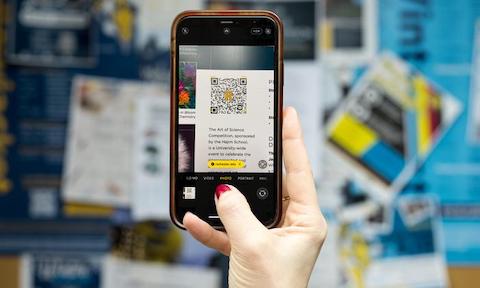
QR codes could get an extra level of security with self-authenticating dual-modulated QR.
Source: University of Rochester photo by J. Adam Fenster
Sharma and his coauthor Irving Barron, an assistant professor of instruction in electrical and computer engineering, have been exploring opportunities to commercialize the technology. They worked with UR Ventures to file a patent for SDMQR codes and secured a National Science Foundation I-Corps grant to explore industry applications, such as replacing traditional UPC barcodes – the 12-digit code and series of bars that typically identify a product – with these more sophisticated QR codes.
In addition to using new shapes for QR codes, the researchers are developing QR codes that can use color to embed more information and allow a single code to drive people to up to three destinations.
Industry Interest
Sharma said their customer discovery research through the NSF I-Corps has shown companies remain interested in the technology because it allows for branded codes that could end up used on packaging to replace the modern black-and-white codes and the UPC codes scanned at checkout aisles.
“Something that has been repeatedly brought up to us is that companies want to move away from having a traditional UPC barcode on their packaging and are increasingly moving to QR codes and other 2D barcodes because of their robustness,” Sharma said. “The footprint is a concern because they want to have as much information in as small an area as possible. Our technology can help them achieve that.”