
The high-voltage technology relies on power line communication technology to transmit smart-grid data between vehicles and charging equipment.
To that end, in a laboratory, a Southwest Research Institute (SwRI) team exploited vulnerabilities in the power line communication layer and were able to gain access to network keys and digital addresses on both the charger and the vehicle.
The research is part of SwRI’s ongoing efforts to help the mobility sector and government improve automotive cybersecurity spanning embedded automotive computers and smart-grid infrastructure.

Moreover, in the latest project, SwRI explored vehicle-to-grid (V2G) charging technologies governed by ISO 15118 specifications for communications between EVs and electric vehicle supply equipment (EVSE) to support electric power transfer.
“As the grid evolves to take on more EVs, we need to defend our critical grid infrastructure against cyberattacks while also securing payments to charge EVs,” said Vic Murray, assistant director of SwRI’s High Reliability Systems Department. “Our research found room for improvements.”
Additionally, the SwRI team developed an adversary-in-the-middle (AitM) device with specialized software and a modified combined charging system interface. AitM allowed testers to eavesdrop on traffic between EVs and EVSE for data collection, analysis and potential attack. Furthermore, by ascertaining the media access control addresses of the EV and EVSE, the team identified the network membership key that allows devices to join a network and monitor traffic.
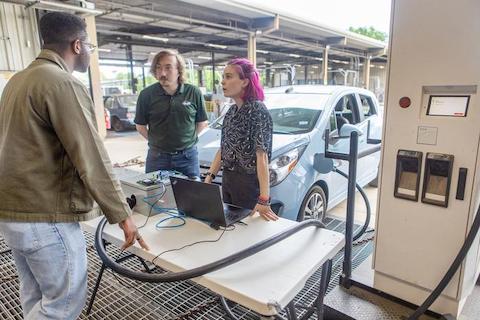
SwRI research engineers, from left, FJ Olugbodi, Mark Johnson and Katherine Kozan demonstrate an adversary-in-the-middle device they developed to test the cyber resiliency of ISO 15118-compliant vehicle-to-grid charging systems.
Source: Southwest Research Institute
“Adding encryption to the network membership key would be an important first step in securing the V2G charging process,” said FJ Olugbodi, an SwRI engineer who contributed to the project. “With network access granted by unsecure direct access keys, the nonvolatile memory regions on power line communication-enabled devices could be easily retrieved and reprogrammed. This opens the door to destructive attacks such as firmware corruption.”
However, encrypting embedded systems on vehicles poses several challenges. For instance, added layers of encryption and authentication could even become a safety hazard. A failure to authenticate or decrypt could interrupt a vehicle’s functionality or performance.
SwRI developed a zero-trust architecture that can address these and other challenges.
It connects several embedded systems using a single cybersecurity protocol. SwRI’s future EV cybersecurity research will test zero-trust systems for PLC and other network layers.
“Automotive cybersecurity poses many layers of complexity, but we are excited about these new techniques to identify and address vulnerabilities,” said Cameron Mott, an SwRI manager leading SwRI’s automotive cybersecurity research.