
Operated by Fieldwood Energy, LLC, the K1 Jumper is 140 miles south of New Orleans, Louisiana, in Green Canyon Area in 2,082 feet of water. The K1 Jumper is 26 miles from the Tarantula Platform in the South Timbalier Area, and connected to the Host Facility by the Katmai Flowline.
An investigation into the July 25, 2020, incident found the failure occurred on the K1 Jumper at a 90-degree connection where the Multi-Phase Flow Meter (MPFM) bottom 4-inch flange met up with the 4-inch studded block (Blind Tee), according to a report with the Bureau of Safety and Environmental Enforcement (BSEE).
The post-incident evaluation revealed the failure occurred due to the fracture of four of the eight flange fastener studs. The four failed studs fractured at the first thread engagement of the nut and were adjacent to one another on the same side of the flange, according to the report.
40 Days In Service
At the time of the incident, the K1 Jumper had been in service less than 40 days, the K1 Well was the only input source into the Katmai Flowline, the K1 Well was shut-in, and the K1 Jumper’s internal pressure of 7,252 psi was below the maximum allowable design pressure.

On March 22, 2020, after subsea installation, the K1 Jumper successfully passed the required pressure test by holding 15,000 pounds-per-square-inch internal pressure for two hours.
On June 18, 2020, the K1 Well started producing oil. Between initial production and July 25, 2020, K1 Well production was shut in six times due primarily to issues encountered on the Host Facility.
On July 25, 2020, at 5:24 p.m. with the well shut-in, an abnormal internal pressure drop occurred in the Katmai Flowline from approximately 7,252 psi to 5,037 psi within one hour. After identifying this pressure drop, personnel on the Host Facility evaluated topsides process equipment, incoming flowlines, and valves for potential leak paths, according to the report. However, the crew could not find a source on the Host Facility to explain the change in pressure.
Onshore and offshore personnel evaluated the possible causes for the pressure drop, according to the report. A decision was made to keep the well shut-in and perform a visual sheen inspection at the GC 40 location. Due to weather and lack of daylight, neither a vessel nor a helicopter could be dispatched that night.
On July 26, 2020, control room operators monitored the Katmai Flowline pressures which were above the mudline hydrostatic seawater pressure and were decreasing at a lesser rate than the previous evening, according to the report.
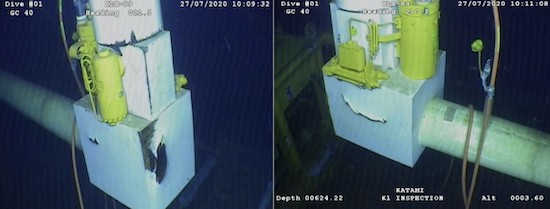
On July 27, 2020, an ROV deployed from a motor vessel performed an inspection of the subsea components downstream of the K1 Tree. ROV live video surveillance identified the potential leak source at or around the MPFM/Blind Tee connection area.Source: BSEE
Vesssel Dispatched
Fieldwood was unable to mobilize a flight due to weather, but a vessel was dispatched to observe the water surface above the Katmai Flowline and K1 Well locations. When the vessel arrived, personnel observed a rainbow-colored sheen on the surface near the K1 Well, prompting personnel on the Host Facility to depressurize the Katmai Flowline. At 3:04 p.m., Fieldwood reported the incident to the BSEE Houma District.
On July 27, 2020, Fieldwood dispatched a remotely operated vehicle (ROV) to survey the Katmai Flowline near the K1 Tree. The ROV survey revealed breaches in the insulation surrounding the flange connection of the MPFM and Blind Tee on the K1 Jumper.
The BSEE Panel identified the following probable causes and contributing causes that led to the pollution event. The Panel also developed the following recommendations for improvement of the existing safety and environmental management systems.
Probable causes for the incident:
- Failure to install American Petroleum Institute (API) 6ACRA-compliant studs in the K1 Jumper MPFM flange connection
- Engineering documentation used for procurement did not specify API 6ACRA compliance for subsea flange fasteners (studs and nuts)
- Gap in the Quality Assurance/Quality Control (QA/QC) process allowed for non-API 6ACRA-compliant subsea flange fastener installation
In addition, there were contributing causes such as: Management of Change (MoC) process was not followed.
Recommendations
Recommendations to consider for improved implementation of existing safety and environmental management systems:
- Utilize an industry-knowledgeable metallurgist to evaluate all current and future subsea fasteners to verify fasteners are fit for service and not prone to Hydrogen Embrittlement or any other environmental cracking failures. For future installations, ensure the metallurgical evaluation is performed during the engineering technical review phase before releasing the engineering design for construction.
- Share Subsea Leak Detection (SSLD) system learnings with industry.
- Emphasize that company, contract, and sub-contract personnel enact MoC when there are modifications associated with equipment, operating procedures, personnel changes, materials, and operating conditions.
- Validate and document flange fastener make-up torque values.
- Ensure SSLD notification system alarms are appropriately set with effective alerts and properly monitored during shut-in, transient, and steady state production operating conditions.
- Consider the subsea leak potential while investigating significant subsea flowline pressure drops even when the pressure trends are above the ambient pressure of the sea.
Click here to view the entire report.