
However, mining at deeper levels presents big challenges, and among the foremost concerns is the occurrence of rockbursts, characterized by sudden and violent releases of accumulated strain energy within the rock mass. Consequently, this poses significant threats to the safety of personnel and the integrity of underground infrastructure.
However, there is a new approach to rockburst risk management, according to a new study from Dr. Ming Cai from Laurentian University in Canada.
Cai’s paper advocates for strategic measures to reduce rockburst hazards and excavation vulnerability, with an emphasis on the importance of ground support systems. Additionally, it explores rockburst warning and prediction, addressing the challenges and highlighting the significance of advanced monitoring techniques and engineering control measures.

“Even if we can predict rockbursts, so what? Assuming that we correctly predict a rockburst’s occurrence time, location and magnitude, we can then evacuate workers from the mining area in a timely fashion,” Cai said. “However, if we do not support the drifts and stopes well against rockburst damage, severe damage to mine openings might lead to disruption of mining operations.”
In extreme cases, it might lead to mine closure. “We want the workers to be safe no matter what; we also want the investment to be safe,” Cai said.
One of the standout aspects is its exploration of multiple lines of control measures.
“The best approach for rockburst risk management is to build a multiple-line defense system, establishing and maintaining multiple lines or layers of defense, each serving a specific purpose,” Cai said.
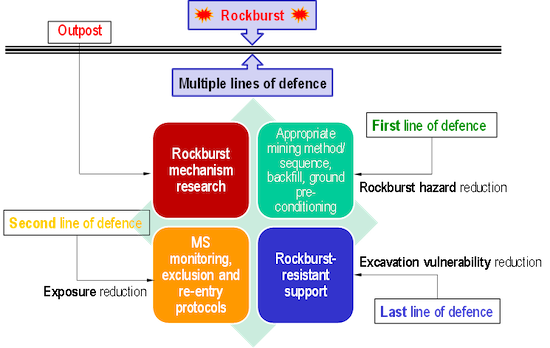
Multiple lines of defense to deal with rockburst problems in deep mines.
Source: Deep Resources Engineering
In particular, improved mine design and mining sequencing aim at reducing the rockburst hazard is the first line of defense, while microseismic monitoring for mitigating the consequences of rockburst is the second line of defense. For the last line of defense, rockburst-resistant support can end up employed to reduce the vulnerability of mine excavations.
Overall, the study contributes to improving safety in mining operations by promoting a multi-faceted approach that combines traditional engineering controls with administrative measures and cutting-edge technologies.
Click here to view the paper.