
Intensifying threats and the connectivity that accompanies digital transformation introduced unprecedented urgency to secure cyber-physical systems (CPS). There is a catch, though, that urgency to enhance CPS security, however, ends up countered by economic tensions that expose a lack of confidence around the integrity and availability of the supply chain, and the shadow of consequential regulatory changes on the horizon.
To that end, respondents remained consistent in expressing their concerns about the protection of CPS in their environments given unpredictable circumstances in the global economy.
Regulatory Mandates
In addition to concerns over reducing cyber risk to key assets and gaining a complete understanding of asset exposures, respondents cited a number of other operational impacts from this uncertainty. Topping that list is an inability to meet regulatory mandates or manage risks from third-party access to CPS.

In that perspective, 49 percent of respondents report supply chain changes caused by shifting global economic policies and geopolitical tensions around the world are leading to increased CPS cybersecurity risk.
Additionally, 45 percent of respondents remain concerned about their ability to reduce CPS cybersecurity risk, and in their overall understanding of their risk posture.
Moreover, organizations with CPS security programs largely standardized on established frameworks such as the NIST Cybersecurity Framework and ENISA in Europe may soon need to build on those frameworks as governments increase regulations.
Source: Claroty
While governments are implementing regulations due to the high risks to critical infrastructure, increasing regulation could disrupt current activities around existing security programs, which at the moment are a blend of industry standard frameworks and government requirements, rather than internal risk assessments, according to the report.
Along those lines, 69 percent of respondents said their current CPS security programs closely adhere to international and local cybersecurity standards or mandates. On the other end, however, 76 percent said emerging regulations may require them to overhaul their current security strategies.
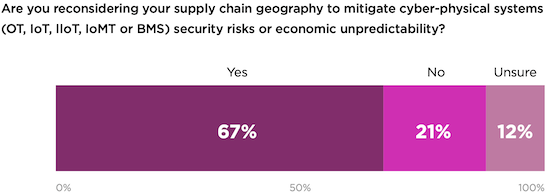
When it comes to reviewing their security programs, 67 percent of respondents said they’re reconsidering their supply chain geography in order to mitigate the risk of economic and geopolitical uncertainty.
Rise in Third-Party Risk
A ripple effect of shifting supply chains is the escalation of risks associated with third-party remote access, as organizations re-evaluate their vendors and introduce new remote access tools into complex and exposed CPS environments, the survey said.
Indeed, 73 percent of respondents are already on this journey, and said third-party remote access to CPS operations is under re-evaluation, with companies demanding visibility into a third party’s security posture.
Third parties remain a focal point as 46 percent of respondents said they’ve been breached in the last 12 months because of third-party access and 54 percent report they found security gaps or weaknesses in vendor contracts post-incident.
As business and cybersecurity leaders face the prospect of shifting supply chain relationships and compliance overhauls, uncertainty only serves to put CPS and critical infrastructure at greater risk.
Companies are confronting the prospect of long, hard looks at their cybersecurity programs as they balance demands for cyber resilience and business continuity, under the cloud of intensifying threats and shifting regulatory mandates. Meanwhile, threats agains operational technology and industrial control systems are on the rise.
Click here to register to download the full report.