
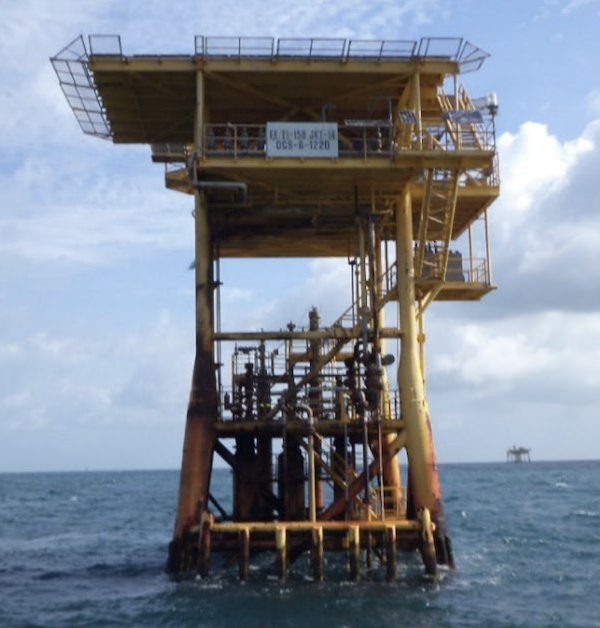
In the On May 15, 2021, incident the FWE Field-Person in Charge (Field-PIC) and the Island Operating Company contract production operator were conducting a pressure test by applying gas to a shut-in gas well’s 16-inch casing when an overpressure event occurred, according to a Bureau of Safety and Environmental Enforcement (BSEE) panel report.
On the morning of the incident, several operator employees and contractors, including the Field- PIC and the operator, attended the daily morning safety meeting held on the Eugene Island Block 158 C-QRT Main Platform (EI 158 C-QRT Platform).
At 7:30 a.m., the Field-PIC and the operator boarded the EI 158 #14 Platform with temporary test equipment that included a 50-foot High Pressure (HP) hose rated for 2,750 pounds per square inch in gauge (psig), a pressure regulator rated for 4,000 psig, and a digital pressure gauge rated for 5,000 psig.

The Field-PIC connected the HP hose to a needle valve on the top of the Well #34 tree without the available pressure regulator and without a pressure safety valve. The Field-PIC was utilizing an existing analog gauge rated for 10,000 psig previously installed at the top of the Well #34 tree to monitor pressure. The operator then boarded the casing deck and connected the opposite end of the HP hose to a needle valve on the 16-inch casing for Well #27.
The operator connected a digital pressure gauge rated for 5,000 psig onto the Well #27 16-inch casing valve to monitor and record the pressure of the 16-inch casing. At 8:00 a.m., the Field-PIC opened the needle valve on the top of Well #34, and the operator opened the needle valve on the Well #27 16-inch casing to begin the test.
The operator was monitoring the test pressure when the 16-inch casing of Well 27 exploded in front of him, releasing fluid through a 11⁄2-inch opening between the 36-inch drive pipe and the wellhead base plate.
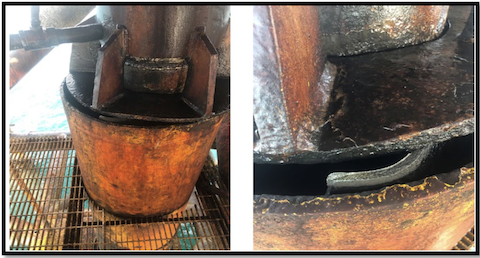
Photographs of Well #27 well head base plate, 36-inch DP, and a piece of 16-inch casing after the explosion.
Source: BSEE
Other operator employees and contractors heard a loud sound, followed by gas escaping, and felt the explosion approximately 1 mile away in the living quarters of the manned EI 158 C-QRT Platform. Witnesses on the EI 158 C-QRT Platform stated they observed black smoke coming from the EI 158 #14 Platform at the time of the explosion, which was a black oily film that released through the 11⁄2- inch opening. Witnesses observed a sheen forming next to the EI 158 #14 platform shortly after the explosion.
The Field-PIC observed the operator laying down on the casing deck. He ran over and found the operator unresponsive and with lacerations to the head and abdomen. The operator ended up flown to Lafayette General Hospital, where doctors pronounced him dead.
At 11:12 a.m., an FWE representative notified BSEE’s Lafayette District Office via its after-hours phone number of a fatality on the EI 158 #14 Platform. The FWE representative said a contractor employee died during work associated with a casing pressure test in the well bay, and the person sustained lacerations to the head and abdomen at 8:10 a.m.
BSEE Gulf of Mexico region director convened a panel to investigate the cause of the fatality. The following are the probable cause, contributing causes, and contributing factors:
The probable cause was the Field-PIC and operator conducted a pressure test using temporary test equipment without using a pressure regulator and pressure safety valve, which resulted in the overpressure and subsequent rupture of the Well #27 16-inch casing.
The contributing causes were:
- FWE failed to develop or implement an adequate hazards analysis (facility level) and a Job Safety Analysis (operations/task level) for the activities on the day of the incident, as described within its Safety and Environmental Management Systems (SEMS) Manual.
- FWE failed to follow its Pre-job Planning Safe Work Practice, as described within its SEMS Manual.
Contributing factors include:
- Based on the manner in which the gauge could switch between output modes, the operator possibly read the digital gauge pressure in units of bars rather than psig.
- FWE failed to conduct a Management of Change, as described within its SEMS Manual.
As a result of its investigation, the BSEE Panel made the following recommendations to industry as a result of its investigative findings:
- Industry should use the hazards analysis to develop procedures to provide to personnel performing the operations, and to enable implementation of all necessary measures of hazard mitigation. All non-routine operations should undergo a hazards analysis by personnel with the appropriate level of expertise.
- Industry should consider implementing processes to assess the risk presented by individual inactive wells and use this assessment to prioritize abandonment. Currently, BSEE analyzes three factors in enforcing well abandonment: lease expiration, idle iron, and casing pressure request denials. There are a significant number of wells on the OCS that are not on expired leases, that do not qualify as idle iron under applicable regulatory guidance, and that are not under casing pressure request denials, but that do have sustained casing pressure indicating some loss of well integrity. If industry assessed these wells for abandonment priority, it could reduce risk to personnel working offshore and to the environment.
- Any time temporary equipment ends up utilized where the source pressure is greater than any downstream components’ pressure rating, they should install a pressure regulating device and a pressure safety valve.
Click here for more on the BSEE’s final report.