
In large-scale or decentralized operations, these issues can reduce the effectiveness of treatment or, worse, lead to dangerous byproducts such as cyanide volatilization. The Fenton reaction – renowned for generating potent oxidants – remains sensitive to pH changes, limiting its applicability in variable environments.
Traditional solutions attempt to broaden the pH range through chemical adjustments, but often at the expense of safety or sensitivity. These challenges highlight the need for self-regulating chemical systems that can autonomously respond to environmental signals, especially pH fluctuations.
Researchers are able to demonstrate how specific iron–ligand complexes enable a self-limiting oxidation process precisely tuned to real-time pH levels. By doing so, the researchers have introduced a “smart Fenton” platform that improves safety, reactivity, and adaptability in water purification, particularly in scenarios involving hazardous or pH-sensitive waste.

At the core of this innovation is a modified Fenton reaction incorporating hydroxylamine (HA) and EDTA.
Modified Reaction
Unlike conventional acidic systems, this configuration generates hydroxyl radicals only when the solution pH is between 7.0 and 10.0. Using benzoic acid as a probe and electron spin resonance (ESR) for detection, the team confirmed up to 69 percent degradation at pH 9.0.
Further computational modeling revealed changes in pH influence the structure – and thus the reactivity – of iron–EDTA complexes. Specifically, [Fe²⁺–EDTA]2−is most effective in activating hydrogen peroxide, while [Fe³⁺–OH–EDTA]2−ends up easily reduced by HA.
These complementary species coexist only within the defined pH range, enabling controlled radical production. Importantly, once the pH drifts out of range, the reaction self-terminates, offering a built-in safety mechanism that avoids harmful byproducts or equipment wear. A multiple-dosing strategy for HA further improves radical stability and extends •OH half-life, enhancing overall system performance in dynamic water environments.
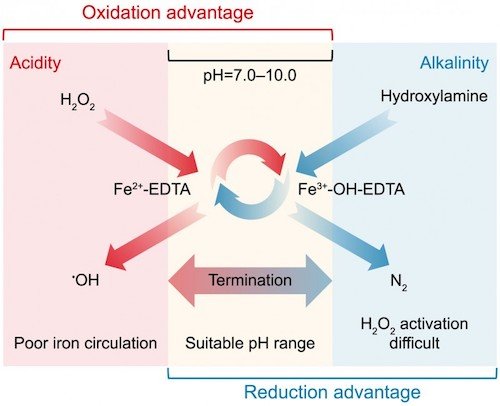
This schematic illustrates the narrow pH range (7.0–10.0) in which the modified Fenton system efficiently produces hydroxyl radicals (•OH) through the interplay of Fe²⁺– EDTA and Fe³⁺– OH–EDTA complexes. Outside this range, either poor iron cycling (in acidic conditions) or difficult H₂O₂ activation (in alkaline conditions) limits reactivity, enabling a built-in pause mechanism for safe and responsive water treatment.
Source: Environmental Science and Ecotechnology
This pH-responsive Fenton system introduces a paradigm shift in oxidation-based water treatment, said Dr. Huabin Zeng, corresponding author of the study. Rather than simply expanding the effective pH range, we’ve designed a process that senses and adapts in real time. It offers built-in safeguards for delicate applications, such as cyanide-containing wastewater, and brings us closer to truly intelligent chemistry in environmental engineering.
The implications of this work are far-reaching for next-generation water management.
Energy Reduction
The system’s automatic shutdown in acidic conditions prevents accidental cyanide volatilization, a major risk in industrial wastewater treatment. It also minimizes chemical overuse and reduces reliance on energy-intensive mixing or pH correction methods.
With its intelligent control, environmental safety, and operational efficiency, the technology paves the way for a new class of self-regulating chemical processes designed for complex, real-world challenges in sustainable water infrastructure.
Click here to view the paper.