
Traditional point-sampling methods have limitations, such as low temporal resolution and a lack of comprehensive coverage of emissions from heterogeneous sources.
These challenges underscore the necessity for more advanced and efficient monitoring systems that can provide real-time, multi-gas data. Based on these challenges, there needs to be in-depth research into more effective emission monitoring systems.
The coherent open-path spectroscopy (COPS) system was deployed at a WWTP to monitor methane (CH4), carbon dioxide (CO2), and nitrous oxide (N2O), ammonia (NH3), carbon monoxide (CO), and water vapor (H2O).

The system, which uses an ultra-broadband mid-infrared light source, demonstrated superior detection capabilities over traditional point-sampling methods, capturing gas concentrations in real-time with high temporal resolution.
The COPS system represents a significant leap forward in emissions monitoring.
Superior Detection
Unlike conventional point-sampling techniques, the COPS system offers continuous, non-invasive monitoring over a broad spectral range (2-11.5 micrometers), allowing for the simultaneous detection of multiple gases. In the field test, the system was able to track CH4 and CO2 emissions above an aeration tank at a WWTP, with clear correlations between gas concentrations and aeration periods.
The system also demonstrated a high level of accuracy in measuring gases such as N2O, NH3, and CO, with results that closely matched those from traditional commercial analyzers.
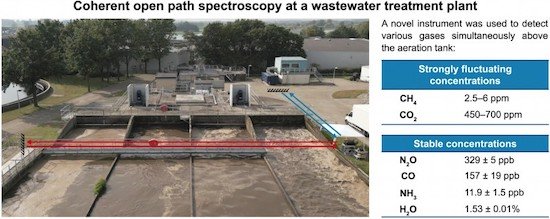
This image illustrates the deployment of a novel coherent open-path spectroscopy (COPS) system at a wastewater treatment plant. The system monitors various gases, such as methane (CH4) and carbon dioxide (CO2), showing fluctuating concentrations, while gases like nitrous oxide (N2O) and ammonia (NH3) exhibit stable levels.
Source: Environmental Science and Ecotechnology
One of the key advantages of the COPS system is its ability to capture emissions across a broad area, overcoming the spatial limitations of point-based measurements. This system can monitor gas emissions from multiple sources simultaneously, offering a more robust, comprehensive method for environmental monitoring.
The system’s ability to detect various gases in real-time with high sensitivity enhances its potential for both industrial and atmospheric emissions assessments.
“The ability to monitor multiple greenhouse gases simultaneously with high precision and minimal interference is a major step forward for environmental monitoring,” said Dr. Simona Cristescu, an expert in analytical chemistry at Radboud University, emphasizing the transformative potential of the COPS system. “This technology not only improves our understanding of emission patterns but also offers a scalable solution for more sustainable wastewater treatment operations.”
Potential for Multiple Industries
The COPS system holds significant promise for improving emissions monitoring in a wide range of industries, especially those with complex, variable emission sources like WWTPs.
By providing real-time data on multiple gases, the system can enhance emission quantification, inform mitigation strategies, and support regulatory compliance. Additionally, the continuous, non-invasive nature of the system makes it a cost-effective and efficient solution for long-term environmental monitoring.
As the technology advances, it could end up applied to other sectors, such as agriculture and industrial manufacturing, to further reduce environmental footprints and improve sustainability efforts.
Click here for more on the study.