
Aqueous zinc batteries are secondary batteries that use water as the electrolyte, offering a safer and more environmentally friendly alternative to lithium-ion batteries, which use volatile liquid electrolytes and pose fire risks.
Their low production cost and inexpensive materials also make them a promising candidate for next-generation energy storage systems (ESS), according to researchers Dr. Jung Hoon Yang and Dr. Chan-Woo Lee of the Energy Storage Research Department at the Korea Institute of Energy Research.
These dendrites can penetrate the separator between the anode and cathode, causing electrical short circuits and significantly compromising the durability of the battery. A dendrite is a phenomenon in which metal ions irregularly deposit on the anode during the charging process, forming elongated, tree-branch-like structures. As these grow in an uncontrolled manner, they can cause internal short circuits, severely compromising battery safety and significantly shortening its lifespan.

Suppressed Dendrite Formation
The research team developed novel copper oxide nanoparticles and successfully suppressed dendrite formation in aqueous zinc-ion batteries using an “electron sponge” technology that effectively absorbs and releases electrons at the anode. The aqueous zinc-ion battery incorporating this technology demonstrated three times greater durability compared to conventional batteries.
The research team tested a range of candidate materials with zinc-alloying properties, analyzing their performance by particle size. As a result, they found that copper oxide nanoparticles exhibited the highest zinc affinity.
Building on this, the research team developed new copper oxide nanoparticles and applied them to aqueous zinc-ion batteries.
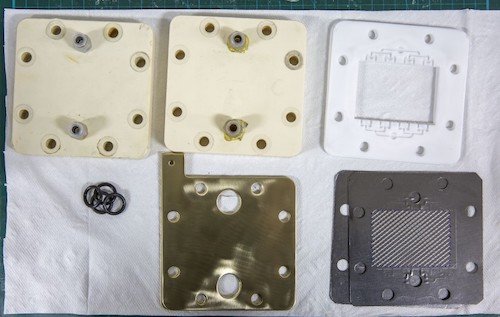
The new copper oxide-based electrode material gained a threefold boost in durability.
Source: Korea Institute of Energy Research
In zinc-ion batteries, electrons meet zinc ions at the anode to form metallic zinc, thereby storing energy. The copper oxide nanoparticles act like a sponge, rapidly absorbing electrons, which enables zinc to deposit evenly around them. This uniform zinc formation effectively suppresses the development of dendrites, which typically arise from irregular zinc growth.
During discharge, the “sponge” rapidly releases electrons, much like squeezing water from a sponge, thereby promoting the dissolution of zinc metal and minimizing residual zinc on the anode surface. This mechanism prevents leftover zinc from growing into dendrites during repeated charge-discharge cycles.
The research team named the technology “electron sponge” and, through computational modeling, demonstrated it can also reduce energy loss during battery charging. When applied to a zinc–polyiodide flow battery, a type of aqueous zinc-based battery, there was no dendrite formation even after 2,500 charge-discharge cycles. In comparison, conventional batteries typically begin to develop dendrites and fail after around 800 cycles, indicating the new technology offers more than three times the durability.
High Efficiency
In addition, the battery exhibited a high efficiency, with a charge-to-discharge capacity ratio of 98.7 percent. It also achieved an energy density of 180 Wh/L, over 30 percent higher than previously reported zinc–polyiodide flow batteries, significantly enhancing its potential for commercialization.
Dr. Jung Hoon Yang and Dr. Chan-Woo Lee, who led the research at KIER, said they expect this study to provide a key breakthrough for the development of next-generation zinc batteries with high performance and safety.
The researchers plan to rapidly proceed with performance validation at a commercial scale by integrating the newly developed copper oxide electrode material into a 3.5 kW-class zinc–polyiodide flow battery demonstration system.