
The thermal safety of lithium-ion batteries remains a critical concern, according to a team of researchers at Southeast University.
Compared to the traditional graphite anode, the Si-C anode poses a higher risk of thermal runaway due to its dramatic volume expansion and more violent reactivity with the electrolyte.
At present, strategies to improve the thermal stability of Si-C anodes mainly focus on two key directions: Electrolyte optimization and solid electrolyte interphase (SEI) modification. However, research into the contribution of intrinsic properties of Si-C materials to the thermal runaway generation mechanism remain insufficient.
To comprehensively elucidate the factors influencing the material aspects of the thermal safety of the Si-C anodes, the team designed and synthesized three types of silicon–carbon materials by modulating the porous hard carbon (pHC) substrate materials and the preparation process: The silicon-carbon (C@pHC-SiC), silicon-carbon with smaller pore volume (C@pHC’-SiC), and silicon-carbon with more floating silicon (C@pHC-SiC’).

Thermal Safety Reduced
The team compared the heat release of three types of Si-C anodes in contact with electrolyte at 100 percent state of charge through the differential scanning calorimetry (DSC) tests. The results indicate the pHC substrate does not exert a significant influence on the thermal safety of Si-C anodes, whereas floating silicon without a carbon layer directly triggers thermal runaway.
In addition, the team conducted DSC tests by combining graphite anodes with different blending ratios of C@pHC-SiC with electrolyte. The results show the amount of exothermic heat is almost positively correlated with the blending ratio of C@pHC-SiC, further illustrating the thermal safety risk increases with the proportion of C@pHC-SiC.
Moreover, accelerating rate calorimeter (ARC) tests show the maximum temperature of the pouch cells with floating silicon achieved 875.2°C (532.1°C) for samples without floating silicon. Researches also further demonstrated the effect of floating silicon on thermal safety.
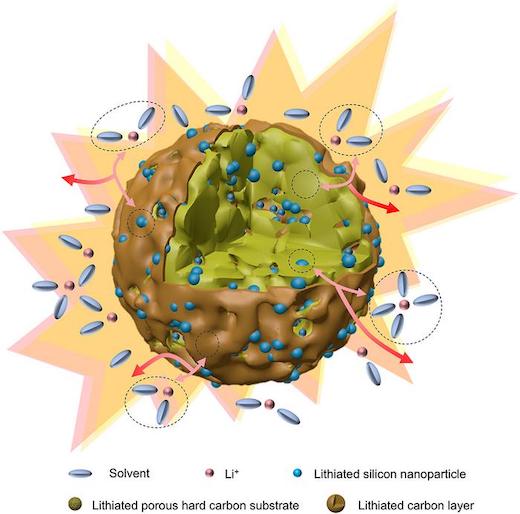
A proposed schematic diagram of potential sources of thermal runaway hazards in Si-C materials, to better visualize the exothermic reaction between Si-C anode and electrolyte.
Source: Xin-Bing Cheng, Southeast University.
Thermal Guidance
“This study provides important insights into the structural design of silicon-carbon composites and offers guidance for evaluating the thermal safety of commercially available anodes with high silicon-carbon content,” said Xin-Bing Cheng, a professor at Southeast University.
“Design strategies for the high thermal stable silicon-carbon materials can end up explored from these three aspects: First, a vase-shaped micropore design of the hard carbon substrate is able to enhance the spatial confinement of nano-silicon particles. The second is to optimize the thickness of carbon coating layer, balance the interface ion transport and structural stability. Finally, the difference in expansion coefficients between the hard carbon substrate and nano-silicon particles upon lithiation should end up addressed to minimize the dynamic escape of nano-silicon particles,” said Dr. Xin Shen, a postdoctor at Southeast University.