
This technology significantly shortens refueling time and reduces the cost of establishing and operating hydrogen refueling infrastructure. By greatly enhancing the safety and efficiency of hydrogen refueling systems, the technology could accelerate the adoption of hydrogen mobility and infrastructure, ultimately strengthening global competitiveness in the hydrogen economy.
A research team led by Principal Researcher Dae-Hwan Kim at the Nuclear Equipment Verification Laboratory of the Busan Machinery Technology Research Center under the Korea Institute of Machinery and Materials (KIMM) successfully developed and demonstrated this new technology using an incompressible fluid.
Traditionally, hydrogen refueling relied on injecting hydrogen cooled to -40°C to prevent a rise in temperature during charging. However, this method results in longer charging times and requires additional cooling systems, which in turn increase infrastructure costs.

The newly developed method stands out by fundamentally eliminating temperature rise using an incompressible fluid, enabling safe and stable hydrogen charging without a cooling system.
Pre-filling Tanks
The principle behind the technology involves pre-filling the hydrogen tank with an incompressible fluid (such as water) before charging. As hydrogen ends up introduced, the fluid is simultaneously extracted, preventing adiabatic compression within the tank. This process mitigates the rapid temperature increase of hydrogen and the corresponding rise in internal pressure, allowing faster and more efficient refueling.
This innovation not only improves charging speed compared to existing methods, but also keeps temperature under control – enhancing user convenience and economic benefits for infrastructure operators.
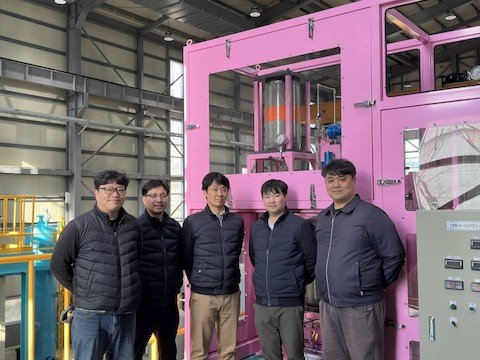
Principal Researcher Dae-Hwan Kim, center, led a group of researchers at the Nuclear Equipment Verification Laboratory of the Busan Machinery Technology Research Center to develop new technology that greatly enhances the safety and efficiency of hydrogen refueling systems.
Source: Korea Institute of Machinery and Materials
Since it does not require high-performance cooling systems, it also offers a substantial reduction in facility setup and maintenance costs. Additionally, by preventing thermal degradation of internal tank components, it improves long-term durability, further lowering maintenance costs for hydrogen vehicles and infrastructure.
“This newly developed technology overcomes the limitations of existing hydrogen charging methods and dramatically improves infrastructure efficiency,” said Principal Researcher Dae-Hwan Kim. “We are currently exploring its potential application not only in vehicles, but also in large-capacity hydrogen containers used in ships, trains, and military vehicles. This will be a pivotal technological advancement for promoting the hydrogen economy and securing global market competitiveness.”