
Now, using a new design of heat exchangers by using additive manufacturing, otherwise known as 3D printing, a new heat exchanger is in development that can dramatically boost functionality.
“The design of heat exchangers, the mechanical geometry configuration of heat exchangers, has not changed in decades,” said Bill King, the project’s leader and a professor and Ralph A. Andersen Endowed Chair of mechanical science & engineering at the University of Illinois Urbana-Champaign.
Precise design of the three-dimensional shapes within these devices can optimize trade-offs among three key factors: The rate of heat transfer, the amount of work that must apply to achieve the transfer, and the size of the heat exchanger. But the traditional manufacturing methods have meant that many desirable shapes were unachievable in practice.

“If you could have any shape at all, it might not be the shapes represented by existing heat exchanger technologies,” King said.
Anything Goes
With additive manufacturing, though, the sky is the limit.
“We can make many, many shapes – almost an infinite number of shapes that are not possible with today’s manufacturing technologies,” King said. “And so we can make shapes that allow for complicated 3D geometries. We can link large passages for fluid flow that promote easy fluid motion, with small passages that promote high heat transfer. So we can make things that have three-dimensional shapes that allow fluids to mix and route in unconventional ways.”
Moreover, in a project with the U.S. Navy, the team successfully designed, made, and tested an additively manufactured two-phase heat exchanger. Furthermore, the refrigerant comes in as a vapor and then cools down and leaves as a liquid, transferring its heat to cooling water that also flows through the heat exchanger.
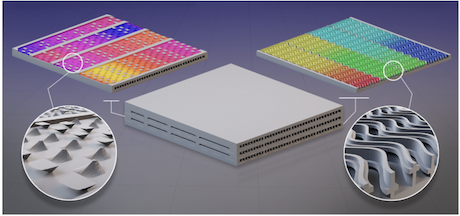
Design of the new heat exchanger showing the exterior shape and internal three-dimensional features. Refrigerant flows through a layer (left) whose shape promotes condensation of the refrigerant, and water flows through wavy fins (right) that offer high heat transfer thanks to their large surface area.
Source: Imaging Technology Group
Furthermore, the device has complicated 3D geometries that significantly improve the heat transfer — geometries that would not have been manufacturable with conventional manufacturing. Additionally, by one measure, their heat exchanger outperforms traditional designs by 30 percent to 50 percent for the same amount of power.
More Efficient Systems
“Making better two-phase heat exchangers is critical for future energy-efficient systems,” said Nenad Miljkovic, the project’s co-leader and a founder professor of mechanical science & engineering at University of Illinois Urbana-Champaign. “With additive manufacturing, we increase the volumetric and gravimetric power density of the heat exchanger, resulting in lower mass and higher compactness. This results in a higher level of performance, and also enables the integration of high-power devices in mobile applications like cars, ships, and aircraft, which classically could not occur with state-of-the-art heat exchanger technology.”
As part of the research, the team developed modeling and simulation tools that allowed them to virtually test tens of thousands of possible configurations with different sizes, shapes, and ways that flows would move back and forth within the heat exchanger. Those tools allowed them to explore and optimize within the huge design space enabled by additive manufacturing.
The Illinois team collaborated with two companies on this project, Creative Thermal Solutions Inc. and TauMat Inc., both of which work on energy efficiency technologies.
The team is now continuing its work in this area, building out modeling capabilities further so they can explore even more designs.