
Yet, remote access now sits at the intersection of every major operational challenge: Expanding vendor ecosystems, rising regulatory pressure, growing cyber risk, and widening internal skill divides, according to Secomea’ s The State of Industrial Remote Access 2026.
Across the globe dataset, organizations express strong confidence in their session visibility, compliance posture, and vendor oversight. But there are deeper issues: While confidence is high, control is inconsistent, and maturity diverges sharply based on remote access model, governance, and collaboration quality.
The most mature organizations combine unified access platforms, shared governance, strong credential hygiene, and deep visibility to achieve predictable, auditable, and resilient operations.

Operational Standard
In the end, identity-centric, unified, and auditable remote access is becoming the operational standard for industrial environments.
Industrial remote access now underpins daily operations across manufacturing and critical infrastructure environments. As organizations scale, rely on more external vendors, and face rising regulatory expectations, the ability to control and audit remote access is vital.
The State of Industrial Remote Access 2026 report provides a clear, data-backed view of how organizations manage remote access today – and which architectural, governance, and operational factors most strongly influence maturity. It highlights where confidence aligns with reality, where gaps persist, and where the industry is heading next.
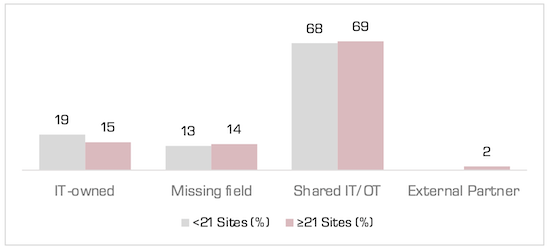
Governance model by operational scale
Source: Secomea
This report aims to answer three essential questions:
1. How secure are industrial organizations in their remote access practices today?
2. Which structural factors – remote access model, governance, alignment, session visibility, vendor workflows – most influence operational outcomes?
3. What direction is the industry moving toward as vendor ecosystems expand,and regulation intensifies?
The report ended up based on a global survey of 400 senior leaders and practitioners involved in OT remote access across manufacturing and critical infrastructure sectors.
Across the global dataset, organizations report strong confidence in their remote access control, session visibility, and compliance readiness. Yet beneath this confidence lies uneven maturity. Differences do not end up driven primarily by region or industry, but by structural factors: Remote access model, governance alignment, vendor oversight, credential discipline, and Zero Trust depth.
Three Forces
Three forces are converging across every region and industry:
As companies operate more sites, remote access becomes more standardized and governed by more stakeholders. Shared IT/OT ownership dominates across all scales, but larger organizations are more likely to involve external partners –an early sign of specialization and the need for consistent processes.
Most organizations now manage 6–20 vendors, with a significant share managing far more. Every vendor adds new access paths, credentials, and workflows. This expansion makes federated control a structural necessity, not a preference.
Different roles experience remote access very differently. OT and IT teams – closest to daily operations – tend to trust vendor compliance more than Compliance and executive roles.
Click here for more information on the report.